Sciatica vs Piriformis Syndrome vs Slipped Disc: How to Identify Your Leg Pain
Leg pain is often confused with muscle strain, tiredness, or a minor injury. If the pain starts in your lower back or buttock and shoots down the leg, it could mean a nerve is irritated.
People often mix up three terms: sciatica, piriformis syndrome, and slipped disc. All three can cause shooting pain, burning, tingling, or numbness in the leg, but they’re different conditions.
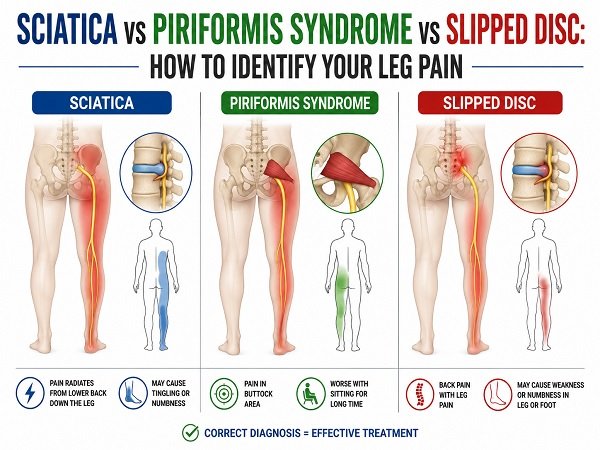
- The simplest way to understand the difference is this: Sciatica refers to a group of symptoms caused by irritation or pressure along the sciatic nerve.
- Piriformis syndrome often feels like sciatica, usually caused by the sciatic nerve getting irritated in the buttocks.
- A slipped disc, more accurately called a herniated disc, can press on a nerve root and cause sciatica.
Understanding where the pain begins, how it travels, and what makes it worse can give you real insight. If symptoms overlap or pain keeps coming back or gets worse, see a spine specialist.
Understanding the Sciatic Nerve
The sciatic nerve is the body’s longest and thickest nerve. It’s made up of nerve roots from the lower spine and runs through the buttock down the leg.
If these nerve roots or the sciatic nerve itself get irritated or pinched, pain can shoot down the path they follow. That’s what most people call it sciatica.
Sciatica may cause:
- Sudden or stabbing leg pain
- Stinging or electric-like pain
- A tingling sensation, like pins and needles.
- Numbness
- Pain that starts in the back or buttocks and radiates down into the thigh, calf, or foot.
- In some cases, muscle weakness
Sciatica typically strikes one side of the body, often due to a herniated disc but other spinal issues can also pinch the nerve roots.
What Is Sciatica?
Sciatica isn’t a disease it’s just a term for symptoms that happen when the sciatic nerve gets irritated or squeezed.
Someone with sciatica often describes the pain as:
“The pain begins in my lower back or butt and radiates down my leg.”
The pain can be light and come and go or so bad it makes walking, sitting, or sleeping tough.
Common Causes of Sciatica
Sciatica can stem from a few different issues, including:
- Herniated or slipped disc
- Bone spurs or wear and tear on the spine over time
- Spinal stenosis happens when the space around the nerves in the spine narrows
- Sometimes, other issues can also put pressure on nerves.
A slipped disc can cause sciatica, but not everyone with sciatica has one.
What does sciatica pain actually feel like?
Sciatica can cause pain that:
- Runs along the back or side of the leg
- It feels sharp, like a burn or an electric
- Worsens with prolonged sitting
- Can get worse when you cough or sneeze.
- Often comes with tingling or numbness
- Can sometimes lead to weakness in the leg or foot.
Where symptoms show up and how bad they are depends on which nerve root is involved.
What Is Piriformis Syndrome?
The piriformis is a tiny muscle tucked deep inside the buttocks. The sciatic nerve typically runs underneath this muscle.
Piriformis syndrome happens when the piriformis muscle or nearby tissues squeeze or irritate the sciatic nerve. This can cause symptoms that look a lot like sciatica.
Common signs of piriformis syndrome
Common symptoms include:
- Sharp, deep ache in the butt
- Pain around the hip
- A burning or tingling sensation in the buttocks
- Pain radiating up into the upper leg
- Pain that gets worse the longer you sit
- Pain gets worse when you walk, run, or move your hip in certain ways.
Piriformis syndrome differs from classic sciatica it’s not caused by the spine but irritation near the buttocks. Diagnosing can be tough since there’s no one test that catches everything and doctors usually have to rule out other possibilities with the same symptoms.
Possible Causes and Triggers
Piriformis syndrome can sometimes be linked to:
- Muscle spasm
- Muscle tightness
- Pain or swelling near the buttocks
- Repetitive physical activity
- Prolonged sitting
- Hip or buttock injuries from falls or trauma
- Improper lifting or movement
- Certain anatomical variations
Buttock pain doesn’t always mean piriformis syndrome other spinal or hip issues can cause the same symptoms, so a proper check-up matters.
What exactly is a slipped disc?
“Slip disc” is a term people often hear, but it doesn’t mean the disc actually slips out of the spine. Check out the common slip disc symptoms to understand how it affects daily movement.
More precise medical terms include:
- Herniated disc
- Slipped disc
- In some cases, a ruptured disc
Spinal discs cushion the bones in your spine. Every disc has a softer core wrapped in a tougher outer layer. A herniated disc happens when the inner material of the disc bulges out through a crack or weak spot.
If the disc presses on a nearby nerve root, it can lead to pain, numbness, tingling, or weakness. In the lower back, this frequently causes sciatica.
Signs of a lumbar slipped disc
A slipped disc in the lower back can lead to:
- Lower back pain
- Pain in the buttock
- Sharp pain shooting down one leg
- Thigh or calf pain
- Foot pain
- Tingling or numbness
- Muscle weakness
Not everyone with a herniated disc on imaging feels any symptoms. The real question is whether the disc issue actually lines up with the person’s symptoms and test results.
Sciatica, Piriformis Syndrome, and a Slipped Disc: How They’re Different
| Feature | Sciatica | Piriformis Syndrome | Slip Disc |
|---|---|---|---|
| What is it? | A pattern of nerve-related pain | A condition involving the piriformis muscle and sciatic nerve | A spinal disc problem |
| Main problems area | Along the sciatic nerve pathway | Deep buttock region | Usually the lower spine |
| Pain may start in | Lower back or buttock | Buttock/hip area | Lower back |
| Leg pain | Common | Can occur | Common if a nerve is compressed |
| Lower back pain | May or may not occur | Often less prominent | Common, though not always present |
| Numbness/ tingling | Can occur | Can occur | Can occur |
| Weakness | Possible in significant nerve involvement | Less typical but possible depending on nerve irritation | Can occur if nerve compression is significant |
| Common relationship | Can be caused by several conditions | Can mimic sciatica | A common cause of sciatica |
Important: This table offers general guidance only symptoms often overlap, so don’t rely on it for a definite diagnosis.
What’s the most likely cause of your leg pain?
1. Where does the pain start?
- Pain starting in the lower back: If pain begins in the lower back and shoots down through the buttock into the leg, it might be sciatica from a herniated disc, something worth looking into.
- The pain is mostly deep in the buttock: If the main pain is deep in the buttock and gets worse when sitting or moving your hip a certain way, it might be caused by the piriformis.
But where something is doesn’t prove what’s wrong.
2. Does coughing or sneezing make it worse?
Coughing or sneezing can sometimes make spinal nerve pain worse, since those actions briefly raise pressure around the spine.
This symptom can show up with sciatica caused by a disc issue, but it’s not enough by itself to confirm a slipped disc.
3. Is Sitting the Primary Cause?
Sitting for too long can make all three conditions worse.
However:
- Sitting can be painful in the buttocks with piriformis syndrome, since the muscle is right there.
- Sciatica from a spinal issue can get worse if you sit for too long.
- A slipped disc can trigger symptoms when you sit, bend, cough, or make certain moves.
That’s why the full symptom picture matters more than any single trigger.
4. Any numbness or muscle weakness?
Numbness, tingling, and weakness are signs of deeper nerve issues you shouldn’t ignore.
A herniated disc pressing on a nerve root can lead to:
- Reduced sensation
- Tingling
- Numbness
- Weakness
- In some cases, it’s hard to lift the foot.
A doctor might test muscle strength, sensation, reflexes, and how you walk to see if nerves are affected.
How Do These Conditions Get Diagnosed?
A thorough medical history and physical examination are the first steps in making a diagnosis.
Your physician might enquire:
- When did the discomfort start?
- Where does the discomfort begin?
- Does it go below the knee?
- Does the pain feel dull, searing, or sharp?
- Do you experience tingling or numbness?
- Is the foot or leg weak?
- Did lifting, exercise, an injury, or extended sitting cause the onset of symptoms?
- Which motions exacerbate the pain?
Assessment of the following may be part of the exam:
- Strength of the legs
- Feeling
- Reflexes
- Strolling
- Hip and back motions
- Particular leg-raising assessments
Further research may be necessary if the symptoms are severe, ongoing, or getting worse. Depending on the clinical circumstances, these may involve MRI, CT, or other testing. For soft-tissue issues like a herniated disc and nerve compression, MRI can be especially helpful. Assessment of nerve or muscle involvement may occasionally be aided by tests like EMG.
Treatment: Is Surgery Always Necessary?
No, most patients who have a herniated disc or sciatica do not necessarily require surgery. You can read more about sciatica pain treatment without surgery for non-invasive recovery options.
The underlying reason, the intensity of the symptoms, and the presence of substantial nerve damage all influence the course of treatment.
Conservative Therapy Could Involve
Treatment options may include the following, depending on a medical professional’s diagnosis and recommendations:
- Maintaining a moderate level of activity as opposed to extended bed rest
- Resting briefly when in terrible pain
- Physical treatment
- Exercises for strength and stretching
- Adjusting your posture
- Treatment with heat or cold
- Medications prescribed by a physician
- Modification of activity
Reducing muscle discomfort and increasing strength and flexibility around the hip and buttock may be the main goals of treatment for piriformis syndrome. Reducing nerve irritation while enhancing mobility and spinal support may be the main goals of treatment for sciatica and disc-related pain.
How About Injections?
Doctors may think about using targeted injections to relieve pain or reduce inflammation in certain patients who have persistent symptoms. Explore advanced pain procedures for chronic pain relief to understand potential non-surgical options. The source of the symptoms will determine the best course of action, which should be determined after a thorough assessment.
When Is Surgery a Possibility?
In certain situations, surgery may be recommended, especially if there is:
- Muscle weakness that is severe or progressive
- Severe compression of the nerves
- Loss of control over one’s bowels or bladder
- Severe pain that does not go away even after receiving the proper non-surgical care
In severe herniated disc cases requiring surgical intervention, procedures like a lumbar discectomy surgery may be performed. However, surgery is not the goal just because an MRI indicates a disc issue. Imaging data, examination findings, and clinical symptoms should all be taken into account.
Red Flag Symptoms: When Is It Time to Get Emergency Medical Help?
Seek immediate medical attention if back or leg discomfort is linked to:
- Abrupt or increasing leg weakness
- Sensation loss that is severe or developing quickly
- Inability to control the bowels or bladder
- Signs after severe trauma
- Excruciating ache that becomes worse quickly
These symptoms need to be evaluated by a doctor very once because they can suggest serious nerve involvement, which could also be associated with a broader spinal cord injury.
Can Disc Issues, Piriformis Pain, and Sciatica Be Prevented?
Although it is not possible to avoid every instance, having a healthy spine and muscles may lower the risk. Age-related changes can also play a role; learn more about whether back and neck pain is a normal part of getting older.
Beneficial Practices Include:
- Maintain an active lifestyle: The muscles surrounding the hips and spine can be supported by adequate strengthening and regular exercise.
- Build up your core: The muscles in your back and abdomen are crucial for maintaining good posture and supporting your spine.
- Avoid prolonged sitting: Take frequent breaks to move around, particularly when working at a desk or travelling long distances.
- When lifting big goods, use the right lifting technique and refrain from abrupt twisting.
- Keep your posture correct: Pay attention to how you sit and stand.
- Before engaging in strenuous activities, warm up your muscles gradually.
- Adhere to a customised fitness regimen: If you now experience leg or back discomfort, exercises should ideally be suggested based on your unique condition. If degenerative changes are present, managing conditions like lumbar spondylosis becomes important for overall spine health.
Final Thoughts: Don’t Overlook Ongoing Leg Pain
Conditions like sciatica, piriformis syndrome, and a herniated disc can lead to leg discomfort, but they stem from different issues.
The key takeaway is:
Sciatica refers to a nerve-related pain experience, piriformis syndrome pertains to the irritation of the sciatic nerve in the buttocks, and a herniated disc is a spinal ailment that can lead to sciatica.
Since these disorders can exhibit similar symptoms, pinpointing the exact cause based solely on the pain location is not always straightforward. Ongoing or intense pain, particularly when accompanied by numbness or weakness, requires thorough medical assessment.
For the evaluation of intricate spine, nerve, and neurosurgical issues, Dr. Deepak Agrawal, a Neurosurgeon at AIIMS New Delhi, offers vast experience in the care of the spine and spinal cord, as well as in spinal surgery. Discover more or check out related patient resources on Dr. Deepak Agrawal’s official site and the educational materials available regarding spinal injuries. His official site details his specialization in the treatment of spine and spinal cord injuries, including spinal instrumentation.
FAQ’s
- How can I determine if my leg pain is due to sciatica or piriformis syndrome?Sciatica typically presents as a nerve-like pain pattern that extends from the lower back or buttock down the leg. In contrast, piriformis syndrome generally involves significant deep pain in the buttock area caused by irritation around the piriformis muscle. Due to overlapping symptoms, a physical exam is often needed to pinpoint the likely cause.
- Can a herniated disc lead to sciatica?Yes. A herniated or slipped disc in the lower back is a frequent cause of sciatica when the disc impacts a nerve root that contributes to the sciatic nerve.
- Does every herniated disc result in pain?No. Some individuals may have herniated discs without experiencing any symptoms. Pain typically depends on various factors, including whether the disc impacts nearby nerves.
- Is it possible for piriformis syndrome to result in pain below the knee?It can lead to spreading sciatic-like symptoms, but the specific pain distribution can vary. Since other conditions like spinal nerve compression can produce similar symptoms, medical assessment may be necessary if the pain persists or is severe.
- Is an MRI scan essential for sciatica?Not always. Imaging is typically considered in cases of severe, worsening, or persistent symptoms, or if physical examination findings indicate a notable underlying issue. A healthcare provider will determine whether an MRI scan or another diagnostic test is suitable.
- Can sciatica recover without undergoing surgery?Certainly. Many instances show improvement with non-invasive treatment methods and time. Surgery is usually only considered for specific scenarios, such as pronounced weakness, bowel or bladder issues, or persistent debilitating symptoms despite appropriate interventions.
- Is it advisable to completely stop all activities when experiencing sciatica?Extended periods of inactivity are generally discouraged. Taking a short break may be beneficial when experiencing intense pain, but a gradual and suitable level of movement is often recommended for recovery. It is important to adjust your activity level based on your symptoms and the guidance of your healthcare provider.
- Can sitting for a long time lead to piriformis syndrome?Continuously sitting for extended periods can lead to irritation or tightness in the piriformis area and could exacerbate symptoms in individuals who are susceptible. This is just one of the potential contributing factors to the syndrome.
- How can sciatic leg pain be alleviated quickly?The most effective treatment varies depending on the underlying cause. Some individuals may find relief through cold or heat therapy, making appropriate changes in their activities, and receiving medical guidance on pain management. If the pain is persistent, severe, or keeps coming back, it is important to seek an evaluation rather than repeatedly trying to manage it on your own.
- When is it recommended to consult a specialist for leg pain related to the spine?It is advisable to seek medical attention if the pain is severe, worsening, persists despite initial care, recurs frequently, or is accompanied by numbness or weakness. Immediate evaluation is necessary if there are changes in bowel or bladder function or sudden significant weakness.
Sources
- https://www.anssiwellness.com/sciatica-vs-piriformis-syndrome-how-to-tell-the-difference/
- https://upwellhealth.com.au/upwell-blog/sciatica-vs-piriformis-syndrome-difference
- https://mindfulmovementphysicaltherapies.com/sciatica-or-piriformis-syndrome/
- https://compedgept.com/blog/piriformis-syndrome-or-sciatica/
- https://acespremortho.com/blog/sciatica-vs-piriformis-syndrome-how-to-tell-the-difference/