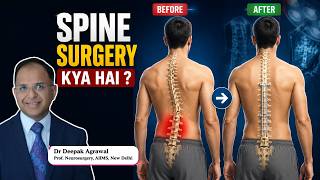



Millions of individuals worldwide suffer from Sciatica Pain, which is one of the most prevalent causes of lower back and leg discomfort. It can range from little discomfort to excruciating pain that makes day-to-day activities difficult.
The good news? Surgery is not necessary for the majority of sciatica cases. Recovery begins with an understanding of the causes, symptoms, and possible non-surgical treatments.
Sciatica Pain: What Is It?
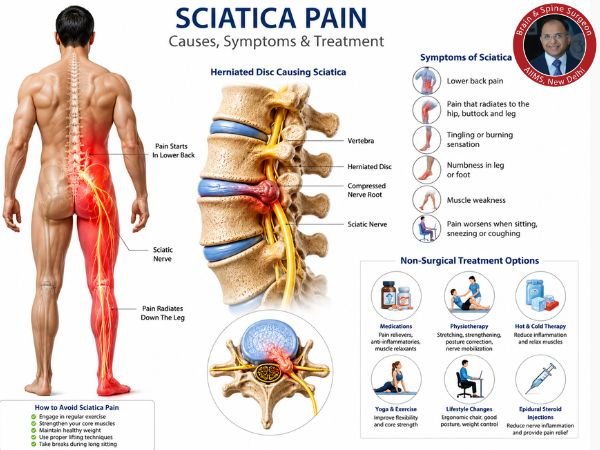
Pain radiating along the Sciatic Nerve, the body’s biggest nerve, is referred to as Sciatica Pain. This nerve travels down each leg, through the hips and buttocks, and from the lower back (lumbar spine).
Sciatica is a sign of an underlying nerve issue rather than a disease in and of itself.
Sciatica Pain Causes
The Sciatic Nerve may be compressed or irritated by a number of conditions:
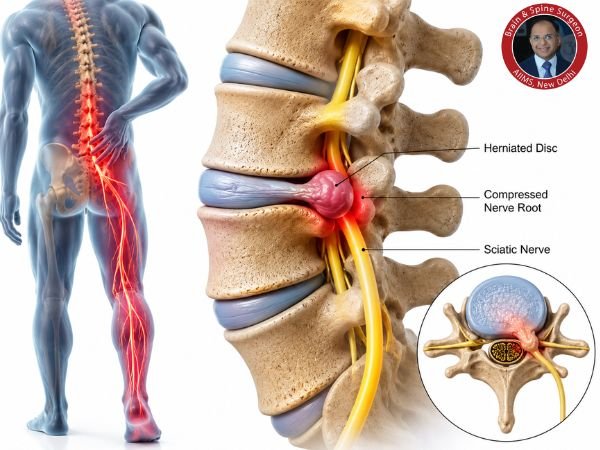
1. A slipped or herniated disc
Among the most typical reasons. A spinal disc’s fragile inner part protrudes and puts pressure on the nerve.
2. Stenosis of the Spine
Spinal canal narrowing that presses against nerves.
3. Disc degeneration
Spinal disc deterioration brought on by ageing.
4. The Piriformis Syndrome
The sciatic nerve is irritated by the piriformis muscle in the buttocks.
5. Spondylolisthesis
A situation in which a vertebra slides over another.
6. Injury or Trauma
The nerve may be directly harmed or compressed by falls or accidents.
Related Post: Slip Disc Symptoms: When Back Pain Becomes Serious
Sciatica Pain Symptoms
Usually affecting one side of the body, Sciatica Pain Symptoms can include:
- Pain that shoots sharply from the lower back to the leg
- Tingling or burning feeling (sometimes known as “pins and needles”)
- Numbness in the foot or leg
- Weakening of the muscles
- Pain that gets worse when you sit, sneeze, or cough
Patients may have trouble standing or walking in extreme situations.
When Is It Time to See a Physician?
Get medical help if you encounter:
- Pain that is severe or getting worse
- Loss of control over one’s bowels or bladder (medical emergency)
- Severe weakness in the legs
- Pain following an accident or injury
The Best Non-Surgical Sciatica Pain Treatment
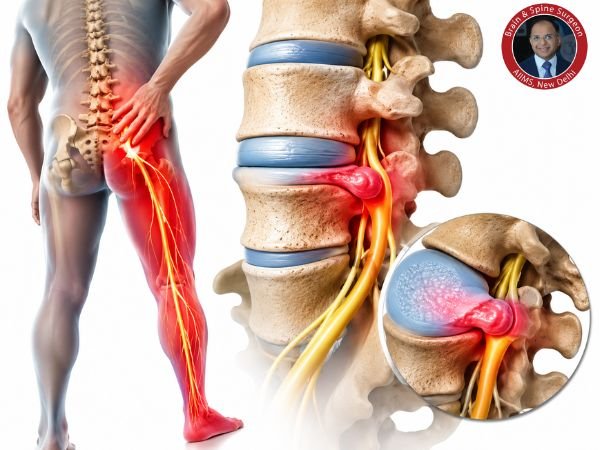
Conservative (non-surgical) treatment improves the majority of patients.
1. Drugs
- Painkillers (NSAIDs, paracetamol)
- Relaxants for muscles
- Drugs for nerve pain
These aid in easing discomfort and reducing inflammation.
2. Physiotherapy (Very Successful)
One of the greatest ways to cure Sciatica Pain is with a planned Physiotherapy program.
It consists of:
- Stretching techniques
- Strengthening of the core
- Adjusting your posture
- Techniques for mobilising nerves
3. Treatment with Hot and Cold
- Ice packs lessen inflammation (first stage)
- Heat treatment increases blood flow and relaxes muscles
4. Changes in Lifestyle
Easy adjustments can greatly lessen symptoms:
- Avoid extended sitting
- Keep your posture correct
- Make use of ergonomic chairs
- Sleep on a mattress that provides support
5. Yoga and Exercise
Mild workouts lessen nerve compression and increase flexibility:
- Walking
- McKenzie exercises
- Yoga positions such as Child’s Pose and Cobra Stretch
6. Injections of Epidural Steroids
Injections can be used to treat chronic pain in the following ways:
- Cut down on nerve-related inflammation
- Provide substantial but brief pain relief
7. Sophisticated Non-Surgical Treatments
- Transcutaneous Electrical Nerve Stimulation (TENS)
- Ultrasound treatment
- Manual treatment
How Much Time Does It Take for Sciatica to Heal?
- Mild cases: two to four weeks
- Moderate cases: six to eight weeks
- Even if they may take longer, chronic patients can still get better with the right care
Is Sciatica Able to Disappear on Its Own?
Yes, with rest and conservative care, sciatica often goes away on its own. Ignoring symptoms, however, can make the illness worse.
How to Avoid Sciatica Pain
- Engage in regular exercise
- Develop your core muscles
- Keep your weight in check
- Stay away of heavy lifting or employ safe approach
- When spending a lot of time sitting down, take breaks
Conclusion
Although Sciatica Pain can be uncomfortable, it is usually very curable without surgery. Recovery is often aided by early diagnosis, appropriate physical treatment, and lifestyle changes.
Seeing a neurospecialist can assist determine the precise source of your Sciatica Pain and direct you toward the best course of action if your symptoms are severe or persistent.
FAQ’s
1. How quickly may sciatica pain be relieved?
The quickest relief is achieved by combining rest, medicine, physiotherapy, and hot/cold therapy.
2. Can sciatica pain be relieved by walking?
Indeed, mild walking lessens nerve compression and increases blood circulation.
3. Is there a lasting solution for sciatica without surgery?
Yes, most of the time. Patients fully recover with the right care and lifestyle modifications.
4. What is the ideal sleeping position for sciatica sufferers?
- With a cushion beneath your knees while on your back
- Place a pillow between your knees while lying on your side
5. Is sciatica a dangerous illness?
Usually not, but serious symptoms like weakness or loss of bladder control need to be treated very away.
6. When does sciatica require surgery?
Surgery is only taken into consideration when:
- Despite treatment, pain continues
- Serious nerve compression is present
- Deficits in the nervous system arise
Sources:
- https://www.ncbi.nlm.nih.gov/books/NBK507908/
- https://pmc.ncbi.nlm.nih.gov/articles/PMC1895638/
- https://pmc.ncbi.nlm.nih.gov/articles/PMC9743914/#fn-group1
- https://pubmed.ncbi.nlm.nih.gov/29939685/
- https://pubmed.ncbi.nlm.nih.gov/20227645/
- https://pubmed.ncbi.nlm.nih.gov/27414674/
- https://pmc.ncbi.nlm.nih.gov/articles/PMC9444434/
- https://www.ncbi.nlm.nih.gov/books/NBK482431/