


Parents may be concerned about irregularities in an infant’s head shape. Among them, two disorders that cause an extended head shape are Scaphocephaly and Dolichocephaly. Despite their apparent similarities, their causes, consequences, and methods of treatment are very different.
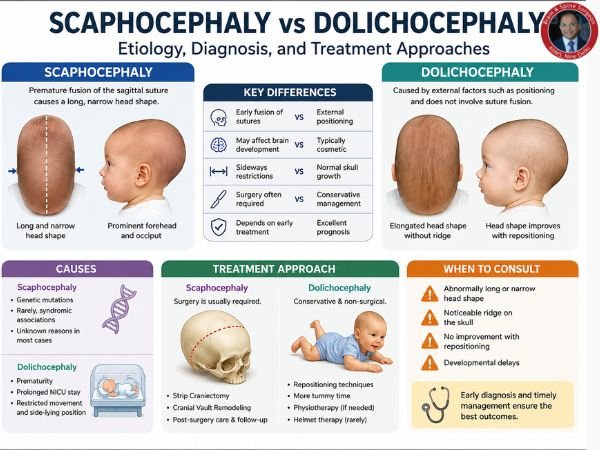
This site offers a thorough, understandable overview of scaphocephaly and dolichocephaly, covering causes, diagnosis, available treatments, and commonly asked questions.
Scaphocephaly: What is it?
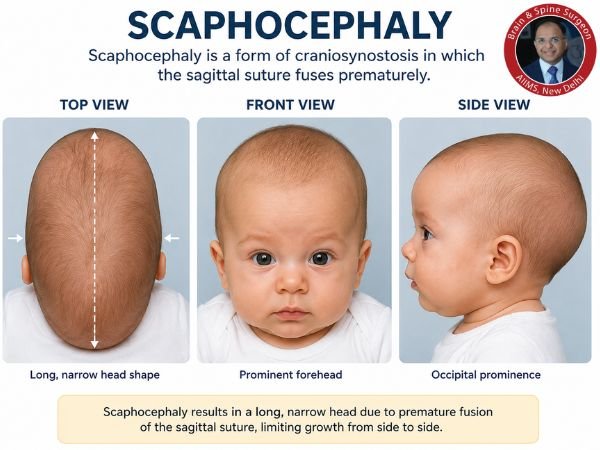
One kind of craniosynostosis, in which one or more of the sutures (joints between the skull bones) fuse too soon, is scaphocephaly. The sagittal suture shuts early in scaphocephaly, which prevents the skull from growing normally laterally and causes it to lengthen from front to back.
Important Features:
- Head shape: long and narrow
- Prominent forehead (frontal bossing)
- Occipital prominence, or a bulging back of the head
- Decreased skull width
Dolichocephaly: What is it?
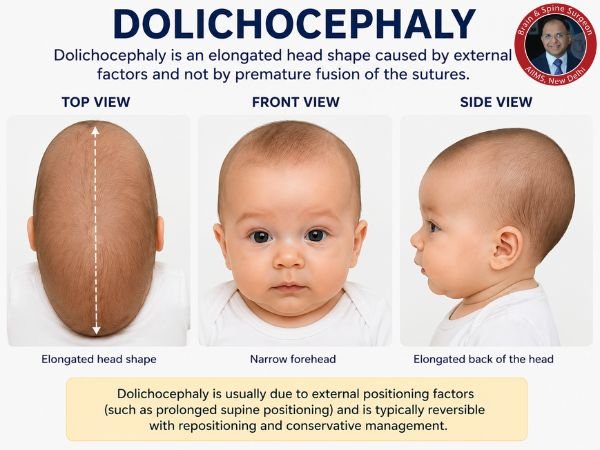
An extended head shape without premature suture fusion is called dolichocephaly. External influences, like prolonged posture, are usually the culprit, especially in premature neonates.
Typical Reasons:
- Early birth
- Extended stays in the NICU
- Restricted movement and a constant side-lying position
Important Features:
- Elongated head form
- Unrestricted expansion of the skull
- Reversible in most cases
Important Distinctions Between Scaphocephaly and Dolichocephaly
| Feature | Scaphocephaly | Dolichocephaly |
|---|---|---|
| Cause | Early fusing of sutures | External placement |
| Level of Severity | May have an impact on brain development | Typically, cosmetic |
| Growth of the Skull | Sideways restrictions | Normal |
| Therapy | Surgery is frequently necessary | Conservative management |
| Prognosis | Depends on receiving therapy early | Excellent |
Etiology (Reasons)
Scaphocephaly:
- Mutations in genes
- Rarely, syndromic connections
- Unknown reasons (the majority of instances are intermittent)
Dolichocephaly:
- Being too young
- External force applied to the skull
- Minimal repositioning
Symptoms to Look Out for
The following indicators are what parents should watch out for:
Regarding Scaphocephaly:
- Elongated and narrow skull
- A ridge on top of the head
- Developmental delay (uncommon but possible)
- Elevated intracranial pressure (in extreme circumstances)
Dolichocephaly:
- Long, ridging-free head shape
- Typical developmental benchmarks
- Repositioning has improved with time
Clinical Examination for Diagnosis
A neurosurgeon assesses:
- Shape and symmetry of the head
- Suture palpation
- Patterns of growth
Imaging Examinations
- The gold standard for craniosynostosis is a CT scan with 3D reconstruction.
- X-rays of the skull (restricted role)
To avoid difficulties, early diagnosis is essential, particularly in cases of scaphocephaly.
Methods of Treatment
1. Scaphocephaly Treatment
Usually, surgery is necessary.
Options for Surgery:
- Strip Craniectomy (early infancy, minimally invasive)
- Remodelling of the Cranial Vault (open surgery for older newborns)
Objectives:
- The proper shape of the skull
- Permit the brain to grow normally
- Lower the intracranial pressure
After-Surgery Care:
- Helmet therapy (in certain situations)
- Frequent follow-up
2. Dolichocephaly Treatment
Conservative and non-surgical.
Options for Management:
- Techniques for repositioning
- More time spent on the stomach
- Physiotherapy (if required)
- Rarely, helmet therapy
Prognosis:
Over time, the majority of infants exhibit notable progress.
When Should I Consult a Neurosurgeon?
Seek professional assessment if:
- The head form seems abnormally thin or lengthy.
- The cranium has a noticeable ridge.
- Repositioning did not improve anything.
- Delays in development are seen.
Better results are guaranteed by early consulting.
Problems if Untreated
Scaphocephaly
- Elevated intracranial pressure
- Delays in development
- Aesthetic abnormality
Dolichocephaly
- Usually, there are no major issues.
- If persistent, cosmetic concerns
Preventive Advice
- Promote tummy time
- Switch up your sleeping positions
- Stay away of applying continuous pressure to one side of the head
- Frequent paediatric examinations
In Conclusion
Despite their similar appearance, dolichocephaly and scaphocephaly require somewhat distinct treatments. While scaphocephaly is a medical disease that frequently necessitates surgical treatment, dolichocephaly is typically benign and treatable with basic procedures.
For the best results and proper brain development, early diagnosis and prompt management are essential. It is very advised that you see a neurosurgeon as soon as possible if you observe any odd head shape in your child.
FAQ’s
1. Is scaphocephaly harmful?
Indeed, it can cause developmental problems and elevated intracranial pressure if left untreated. Excellent results are possible with early surgery.
2. Is dolichocephaly self-correcting?
Yes, most of the time. The head shape naturally improves with correct placement and maintenance.
3. When is the best time to start treatment?
For optimal effects, ideally within the first three to six months, particularly in cases of scaphocephaly.
4. Are babies safe to have surgery?
Yes, it is safe and very successful when done by skilled neurosurgeons.
5. Is helmet therapy effective?
In mild cases or after surgery, helmet therapy can be beneficial, but it cannot replace surgery in cases of craniosynostosis.
6. Can brain development be impacted by these conditions?
If left untreated, scaphocephaly may impact brain development. Usually, dolichocephaly doesn’t.
7. How can parents tell the difference between the two?
One significant distinction is that dolichocephaly lacks a bony ridge, whereas scaphocephaly has one. An expert assessment is necessary.
Sources
- https://www.ncbi.nlm.nih.gov/books/NBK567753/
- https://pubmed.ncbi.nlm.nih.gov/33620830/
- https://pubmed.ncbi.nlm.nih.gov/3614493/
- https://pubmed.ncbi.nlm.nih.gov/16156241/
- https://pubmed.ncbi.nlm.nih.gov/28216483/
- https://pmc.ncbi.nlm.nih.gov/articles/PMC3227159/
- https://www.ncbi.nlm.nih.gov/medgen/65142
- https://pmc.ncbi.nlm.nih.gov/articles/PMC7940292/#Sec2