Overview
A serious public health issue, traumatic brain injury (TBI) can affect multiple areas of the brain, including the thalamus—a small yet vital structure responsible for sensory, motor, and cognitive functions. Because the thalamus acts as the brain’s primary relay station, a thalamic injury after traumatic brain injury can lead to significant neurological complications.
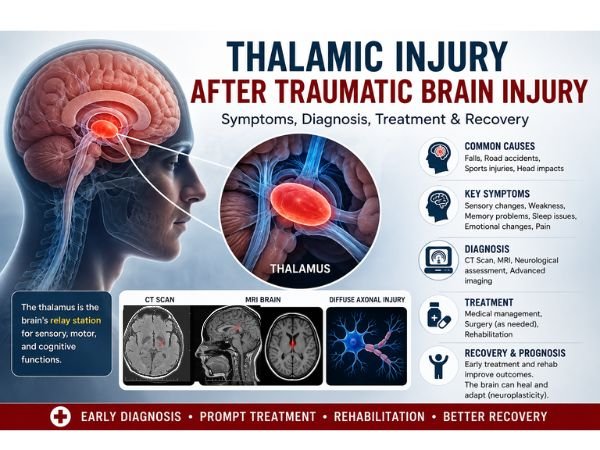
Early diagnosis, prompt treatment, and comprehensive rehabilitation play a crucial role in improving recovery outcomes. This guide explains the pathology, symptoms, diagnosis, treatment, recovery, and prognosis of thalamic injury after traumatic brain injury in simple language.
Why is the Thalamus Important and What Is It?
Located deep inside the brain, the thalamus is a small but essential structure that acts as a communication center between different parts of the brain.
Its major functions include:
- Transmitting touch, pain, and temperature signals
- Managing motor functions
- Controlling sleep and consciousness
- Regulating emotions and memory
Because of its critical role, damage to the thalamus can affect multiple body systems simultaneously.
After a Traumatic Brain Injury, What Is Thalamic Injury?
A thalamic injury after traumatic brain injury (TBI) occurs when the thalamus is damaged due to trauma such as:
- Falls
- Road traffic accidents
- Sports injuries
- Head impacts
- Physical assault
The injury may be:
Direct Injury
- Caused by direct impact
- May result in thalamic hemorrhage or tissue damage
Indirect Injury
- Caused by diffuse axonal injury (DAI)
- Brain swelling (edema)
- Reduced blood supply
Thalamic injuries are most commonly associated with moderate to severe traumatic brain injuries.
Pathology: What Takes Place in the Brain?
Following a traumatic brain injury, the thalamus undergoes several pathological changes.
1. Primary Injury
The primary injury occurs immediately after trauma due to mechanical force.
It may cause:
- Tissue damage
- Thalamic hemorrhage
- Cell destruction
2. Secondary Damage
Secondary injury develops over several hours or days.
It includes:
- Brain swelling (edema)
- Reduced oxygen supply
- Inflammatory response
- Neurochemical imbalance
These changes can worsen the initial brain injury.
3. Diffuse Axonal Injury (DAI)
Diffuse Axonal Injury (DAI) causes:
- Shearing of nerve fibers
- Damage to connections between the thalamus and other brain regions
- Reduced communication within the brain
4. Brain Inflammation
After injury, the immune system activates an inflammatory response.
This may:
- Slow healing
- Increase tissue damage
- Contribute to long-term neurological problems
Typical Reasons for Thalamic Damage
Common causes include:
- Road traffic accidents
- Falls (especially in older adults)
- Sports-related injuries
- Assault or head trauma
- Workplace accidents
Thalamic Injury Symptoms
Symptoms depend on the location and severity of the injury.
Sensory Symptoms
Patients may experience:
- Loss of sensation
- Altered sensation
- Burning or tingling pain
- Central Pain Syndrome
Motor Symptoms
Motor-related symptoms include:
- Weakness on one side of the body
- Poor coordination
- Difficulty walking
- Movement disorders
Cognitive and Behavioral Changes
Patients may develop:
- Memory problems
- Difficulty concentrating
- Confusion
- Reduced awareness
Sleep and Consciousness Problems
Possible symptoms include:
- Excessive sleepiness
- Difficulty staying awake
- Reduced consciousness
- Coma in severe cases
Emotional Changes
Some patients experience:
- Mood swings
- Anxiety
- Depression
- Emotional instability
Central Pain Syndrome (Thalamic Pain Syndrome)
One of the most challenging complications is Central Pain Syndrome, also known as Thalamic Pain Syndrome.
Symptoms include:
- Severe chronic pain
- Burning sensations
- Stabbing pain
- Pain triggered by light touch
- Pain caused by temperature changes
This condition often requires long-term pain management.
How Can Thalamic Injury Be Identified?
Accurate diagnosis is essential for successful treatment.
Doctors may recommend:
1. CT Scan
A CT scan helps detect:
- Brain bleeding
- Skull fractures
- Acute brain injury
2. Brain MRI
MRI provides detailed images and helps identify:
- Thalamic damage
- Diffuse Axonal Injury (DAI)
- Small lesions
3. Neurological Assessment
Doctors evaluate:
- Consciousness
- Muscle strength
- Reflexes
- Sensory function
- Coordination
4. Advanced Brain Imaging
When required, advanced tests include:
- Functional MRI (fMRI)
- Diffusion Tensor Imaging (DTI)
These scans help assess nerve pathway damage.
Options for Treatment
Treatment depends on the severity of the injury.
Emergency Management
Initial care focuses on:
- Maintaining airway, breathing, and circulation
- Controlling intracranial pressure
- Managing bleeding
- Stabilizing the patient
Medical Care
Doctors may prescribe medications for:
- Brain swelling
- Pain control
- Seizure prevention
- Neuroprotection
Surgical Intervention
Surgery is required only in selected cases such as:
- Significant bleeding
- Increased intracranial pressure
Procedures may include:
- Hematoma removal
- Decompressive surgery
Rehabilitation
Rehabilitation is one of the most important parts of recovery.
It may include:
Physiotherapy
- Improves mobility
- Restores strength
- Enhances balance
Occupational Therapy
- Helps patients regain daily living skills
- Promotes independence
Speech Therapy
- Improves communication
- Assists swallowing when needed
Cognitive Therapy
- Enhances memory
- Improves attention
- Supports problem-solving sk
Prognosis and Recuperation
Recovery varies from person to person.
Factors Influencing Recovery
Several factors determine the outcome, including:
- Severity of injury
- Patient’s age
- Speed of medical treatment
- Access to rehabilitation
What to Anticipate
Recovery outcomes may include:
- Mild injuries may recover completely.
- Moderate injuries may result in partial disability.
- Severe injuries can cause long-term impairment.
Recovery may take:
- Weeks
- Months
- Several years
Can Thalamic Injury Cause Recovery in the Brain?
Yes.
The brain has an incredible ability called neuroplasticity, allowing it to reorganize and adapt after injury.
With appropriate rehabilitation:
- Other brain regions may compensate for lost functions.
- Symptoms can gradually improve.
- Quality of life can significantly increase.
Preventive Advice
You can reduce the risk of traumatic brain injury by:
- Wearing a helmet while cycling or riding motorcycles
- Wearing seat belts in vehicles
- Avoiding risky behavior
- Preventing falls in older adults
- Following workplace safety guidelines
When Is It Time to See a Physician?
Seek immediate medical attention if you notice:
- Reduced consciousness
- Persistent headache
- Weakness or numbness
- Confusion
- Unusual behavior
- Severe pain after a head injury
Early treatment greatly improves recovery outcomes.
In Conclusion
Following traumatic brain injury, a thalamic injury is a serious neurological condition that can affect movement, sensation, cognition, sleep, and emotional well-being.
Early diagnosis, prompt medical management, and structured rehabilitation are essential for the best possible recovery.
Many patients regain independence and significantly improve their quality of life through expert medical care and advances in modern neuroscience.
If you or a loved one has suffered a head injury, consult an experienced neurosurgeon. Dr. Deepak Agrawal (AIIMS Delhi) is well known for managing complex traumatic brain injuries using advanced evidence-based treatment approaches.
Frequently Asked Questions (FAQs)
1. Is a thalamic injury potentially fatal?
Yes. Severe thalamic injuries can be life-threatening, especially when accompanied by brain swelling or hemorrhage.
2. Is it possible to reverse thalamic damage?
Complete recovery is not always possible, but many patients experience significant improvement with appropriate treatment and rehabilitation.
3. How long does it take to recover from a thalamic injury?
Recovery varies depending on the severity of the injury and may take several weeks, months, or even years.
4. Can a thalamic injury cause permanent disability?
Yes. Severe injuries may lead to long-term physical, cognitive, emotional, or sensory impairments.
5. What is the most common symptom of thalamic injury?
Pain and sensory disturbances are among the most common symptoms.
6. Is surgery always necessary?
No. Surgery is only required in cases involving severe bleeding or increased intracranial pressure.
7. Does rehabilitation help recovery?
Yes. Physiotherapy, occupational therapy, speech therapy, and cognitive rehabilitation are essential for improving function and quality of life.