With the development of sophisticated intraoperative imaging tools during the past 20 years, spine surgery has undergone tremendous change. The O-Arm navigation system and the conventional C-Arm fluoroscopy system are two of the most popular systems. While both aid surgeons in seeing the spine during surgery, their precision, radiation exposure, and surgical results are very different.
This guide explains all you need to know to determine whether O-Arm or C-Arm navigation is superior for spine surgery.
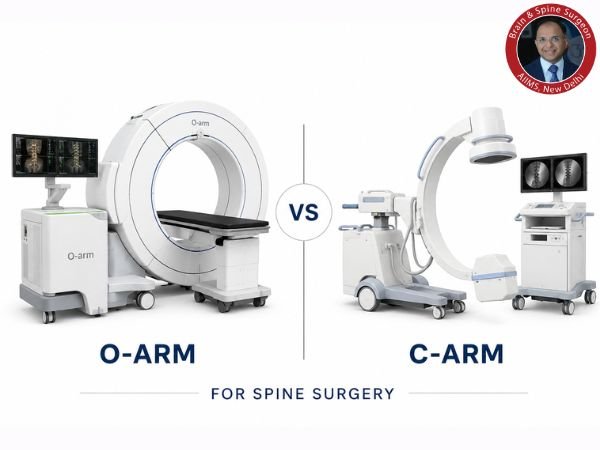
In Spine Surgery, What Is a C-Arm?
A movable X-ray imaging tool called a C-Arm is frequently utilised in spine and orthopaedic procedures. During the procedure, it offers 2D X-ray pictures of the spine in real time.
How It Operates
- The device has a “C” form.
- It revolves around the patient.
- Offers real-time fluoroscopic pictures.
- Aids in directing screw alignment and location.
Benefits of C-Arm
- In hospitals, widely accessible
- Less expensive than more sophisticated systems
- Beneficial for standard spine procedures
Restrictions
- No complete 3D vision; only 2D imagery
- Increased radiation exposure for both patients and surgeons
- In complex spinal abnormalities, less accurate
- In challenging situations, there is a higher chance of misplaced screws
O-Arm Navigation in Spine Surgery: What Is It?
During spine surgery, the O-Arm navigation system, a cutting-edge imaging tool, delivers real-time 3D CT-like images. For extremely precise screw placement, it is typically paired with a navigation system.How It Operates
- The O-Arm completes a 360-degree rotation around the patient.
- Creates a three-dimensional picture of the spine.
- A navigation system is connected to data.
- A surgeon can precisely track instruments in real time.
Benefits of O-Arm
- High-precision 3D imaging
- Very precise positioning of pedicle screws
- Reduced rates of revision (re-operation)
- Decreased radiation exposure for the surgical team
- Ideal for complicated spine procedures (trauma, deformity, tumours)
Restrictions
- Expensive technology
- Not accessible at every hospital
- Requires knowledge and experience.
- A little bit longer setup time
O-Arm vs. C-Arm: Important Distinction
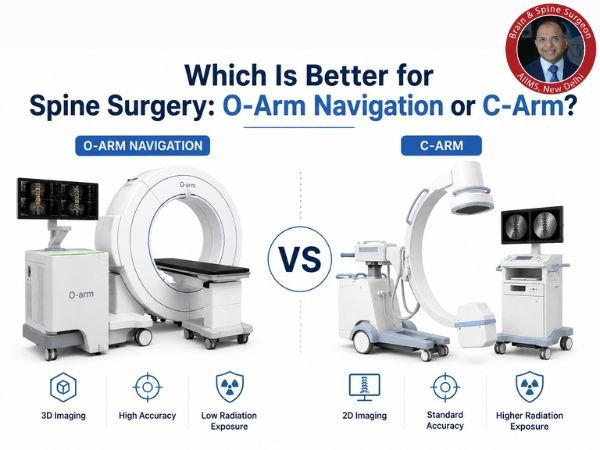
Interpretation
- O-Arm is exceptionally safe and precise.
- C-Arm is still more affordable and widely available.
Which Is Better for Surgery for the Spine?
The type of surgery and the patient’s condition will determine the response.
O-Arm Performs Better When
- Complex spinal abnormalities (kyphosis, scoliosis)
- Surgeries for tumours
- Revision procedures for the spine
- High-risk locations for pedicle screw implantation
- Precision-based minimally invasive spine surgery
C-Arm Works Best When
- Basic fractures
- Regular fixation of the spine
- Insufficient hospital resources
- In emergency situations, speed is crucial
Radiation Exposure: A Significant Distinction
The surgical team’s lower radiation exposure is one of the O-Arm navigation system’s main benefits.
- C-Arm: Higher cumulative exposure due to continuous fluoroscopy
- O-Arm: One-time 3D scan → much reduced exposure when navigating
For surgeons who conduct numerous treatments every day, this is very crucial.
Precision in Screw Positioning
In order to prevent nerve or spinal cord damage during spine surgery, pedicle screw precision is crucial.
- O-Arm navigation: Highly accurate, nearly real-time guided screw placement
- C-Arm: More likely to be misplaced in complex anatomy due to reliance on 2D images
O-Arm-assisted navigation has been found to substantially lower screw revision rates.
Cost vs Benefit
O-Arm systems are costly, yet they provide:
- Improved surgical results
- Reduced rates of complications
- Less revision surgeries
C-Arm is the backbone of spine surgery in most hospitals due to its price and broad availability.
In Conclusion
In spine surgery, O-Arm navigation and C-Arm fluoroscopy are both useful instruments. But:
- O-Arm stands for enhanced surgery, safety, and precision.
- C-Arm stands for frequent use, cost friendly, and accessibility.
Because of its better accuracy and safety profile, O-Arm navigation is becoming the favoured option in current neurosurgery practice, particularly because of high accuracy and safety profile.
FAQ’s
1. Compared to C-Arm surgery, is O-Arm surgery safer?
Indeed, O-Arm’s 3D navigation reduces the danger of complications and improves accuracy in challenging circumstances.
2. Is O-Arm utilised in all hospitals?
No, because of its high cost, it is mostly offered in advanced tertiary care facilities.
3. Is radiation totally eliminated by O-Arm?
No, although compared to C-Arm, it greatly lowers the surgical team’s radiation exposure.
4. Is C-Arm out of date?
Not at all. For standard spine surgeries, C-Arm is still a popular and useful tool.
5. For spinal fusion surgery, which is preferable?
C-Arm might be adequate for basic fusion. O-Arm is better for complicated or revision scenarios.
6. Does O-Arm speed up healing?
In a way, yes recovery may go more smoothly due to improved precision and fewer issues.
7. Do patients pay more for O-Arm surgery?
Indeed, the use of modern technology may result in higher surgery costs.
Sources
- https://pubmed.ncbi.nlm.nih.gov/39742563/
- https://pubmed.ncbi.nlm.nih.gov/39781636/
- https://www.tandfonline.com/doi/full/10.1080/02688697.2016.1206179
- https://www.tandfonline.com/doi/full/10.1080/02688697.2016.1206179
- https://www.jmirs.org/article/S1939-8654(24)00562-9/abstract
- https://www.academia.edu/97651041/O_arm_navigation_versus_C_arm_guidance_for_pedicle_screw_placement_in_spine_surgery_a_systematic_review_and_meta_analysis
- https://www.researchgate.net/publication/338433741_O-arm_navigation_versus_C-arm_guidance_for_pedicle_screw_placement_in_spine_surgery_a_systematic_review_and_meta-analysis
- https://pubmed.ncbi.nlm.nih.gov/31912228/