A severe injury to the neck’s second cervical vertebra (C2) is called a Hangman’s fracture. The name comes from the kind of fracture pattern that has historically been observed in judicial hangings, despite the fact that it may seem frightening. These days, falls, sports injuries, and traffic accidents are the main causes.
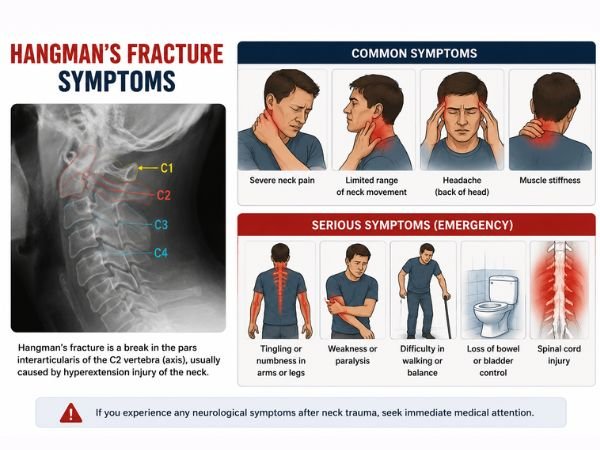
In order to avoid serious consequences like neurological damage or spinal instability, early diagnosis and prompt treatment are crucial.
A Hangman’s Fracture: What is it?
A bilateral fracture of the pars interarticularis of the C2 vertebra (axis) is known as a Hangman’s fracture. This vertebra is essential for maintaining head rotation and mobility.
Hyperextension of the neck, in which the head is violently thrust backward, is frequently the cause of the injury.
Reasons behind Hangman’s Fracture
Typical reasons consist of:
- Road traffic accidents (RTAs), particularly those involving fast-moving vehicles
- Falls from a height
- Sports-related injuries (diving, contact sports, etc.)
- Trauma involving abrupt neck backward movement
Due to improving road conditions and growing vehicle density, RTAs are the primary cause in India.
Hangman’s Fracture Symptoms
The degree of the fracture and the stability of the spine can affect the symptoms.
Typical Signs:
- Terrible neck ache
- Limited neck range of motion
- Stiffness of the muscles
- Headache, particularly in the back of the head
Serious Symptoms (Emergency Medical Situation):
- Tingling or numbness in the arms or legs
- Paralysis or weakness
- Having trouble walking or staying balanced
- Loss of control over the bowels or bladder
Note: If neurological signs are apparent, prompt medical attention is essential.
Hangman’s Fracture Diagnosis
Appropriate treatment requires a prompt and accurate diagnosis.
1. Clinical Assessment
- Evaluation of symptoms
- Neurological assessment
- Trauma history
2. Imaging Examinations
X-ray
- First screening device
- May exhibit C2 vertebral displacement
Gold Standard CT Scan
- Offers precise bone imaging.
- Aids in categorising the severity of fractures
MRI
- Assesses soft tissue, ligament, and spinal cord injuries.
- Vital if there are neurological signs
Hangman’s Fracture Classification
Physicians categorise this fracture according on its stability and severity:
Type I
Minimal displacement and stable fracture
Type II
Some instability and displacement
Type IIa
Significant displacement but severe angulation
Type III
Facet joint dislocation and severe displacement
Treatment choices are guided by this classification.
Options for Hangman’s Fracture Treatment
The degree of instability and the fracture’s severity determine the course of treatment.
1. Non-Surgical Care
Suggested for stable fractures (Type I and certain Type II cases):
- Neck brace or cervical collar
- Immobilisation with a halo vest (in some situations)
- Pain control
- Frequent imaging follow-up
With conservative treatment, the majority of patients make a full recovery.
2. Surgical Intervention
Surgery is necessary when:
- Fractures that are unstable
- Serious displacement
- Conservative treatment’s failure
- Deficits in the nervous system
Typical Surgical Techniques
a. C2-C3 Anterior Cervical Fusion
- Uses screws and plates to stabilise the spine.
- Keeps alignment
b. Fixation from the Back
- Includes rods and screws positioned from the back
- Offers robust stabilisation
c. The Combined Method
- Utilised in complicated situations
Surgery Seeks To:
- Maintain spinal stability
- Avoid neurological harm
- Return to the original alignment
Healing and Rehabilitation
Depending on the severity of the damage and the type of therapy, recovery differs.
Important Features:
- Period of immobilisation: 6–12 weeks
- Physiotherapy: To regain strength and mobility
- Frequent follow-ups: To track recovery
With the right care, the majority of patients may resume their regular activities.
Problems if Untreated
Ignoring a Hangman’s fracture may result in:
- Persistent neck discomfort
- Instability of the spine
- Deficits in the nervous system
- Long-term impairment
Results are greatly improved by early intervention.
Preventive Advice
- When driving, always fasten your seat belt.
- When riding a two-wheeler, wear a helmet.
- Avoid diving in shallow water.
- Observe traffic safety precautions.
- When playing sports, wear the appropriate protective gear.
When Should I Consult a Neurosurgeon?
Get a consultation right away if you encounter:
- After trauma, persistent neck pain
- Movement difficulties
- Limb weakness or tingling
- Any symptoms related to the nervous system
A timely diagnosis has the potential to save lives.
In Conclusion
A Hangman’s fracture is a severe cervical spine injury that needs to be diagnosed and treated right away. Both non-surgical and surgical therapies provide great results thanks to advances in neurosurgical procedures, especially when directed by skilled professionals.
Seeking professional care is essential if you or a loved one has sustained a neck injury. A highly skilled professional such as Dr. Deepak Agrawal, Neurosurgeon at AIIMS Delhi, guarantees precise diagnosis, cutting-edge treatment, and optimal recovery results.
Early medical intervention helps avoid long-term problems and incapacity in addition to improving healing.
FAQ’s
1. Is a Hangman’s fracture potentially fatal?
It can be dangerous, particularly if a spinal cord injury is involved. Nonetheless, the majority of individuals recover well with prompt treatment.
2. Is it possible for a Hangman’s fracture to heal without surgery?
Yes, with the right medical monitoring and a neck brace, stable fractures can recover.
3. How much time does it take to recover?
Usually, recovery takes six to twelve weeks, but depending on the severity, complete rehabilitation may take longer.
4. Will my neck be able to move freely again?
With early treatment and physical therapy, the majority of patients regain good function.
5. Is surgery dangerous?
Although there are hazards associated with any surgery, modern neurosurgery techniques are extremely safe and effective when carried out by qualified specialists.
6. Can paralysis result from this injury?
Yes, if there is damage to the spinal cord. Treatment right away greatly lowers this danger.
Sources
- https://www.ncbi.nlm.nih.gov/books/NBK519496/
- https://pubmed.ncbi.nlm.nih.gov/33044269/
- https://pubmed.ncbi.nlm.nih.gov/28816880/
- https://pmc.ncbi.nlm.nih.gov/articles/PMC10312205/
- https://pubmed.ncbi.nlm.nih.gov/34059978/
- https://pubmed.ncbi.nlm.nih.gov/39315683/
- https://pubmed.ncbi.nlm.nih.gov/31005699/
- https://pubmed.ncbi.nlm.nih.gov/19423417/