Overview
If left untreated, cervical facet dislocation, a dangerous spinal injury affecting the neck (cervical spine), can cause excruciating pain, instability, and even paralysis. High-impact trauma, such as falls, car accidents, or sports injuries (traumatic brain injury), is typically the cause of this illness. To avoid long-term issues, early diagnosis and adequate treatment are essential.
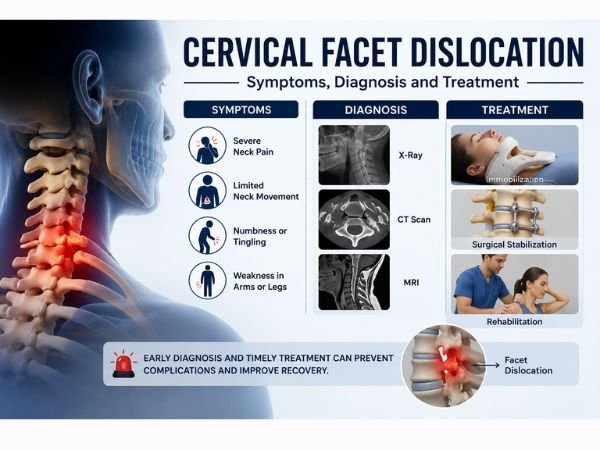
Everything a person needs to know about cervical facet dislocation, its symptoms, causes, diagnosis, available treatments, and recovery will be covered in this guide.
Cervical Facet Dislocation: What Is It?
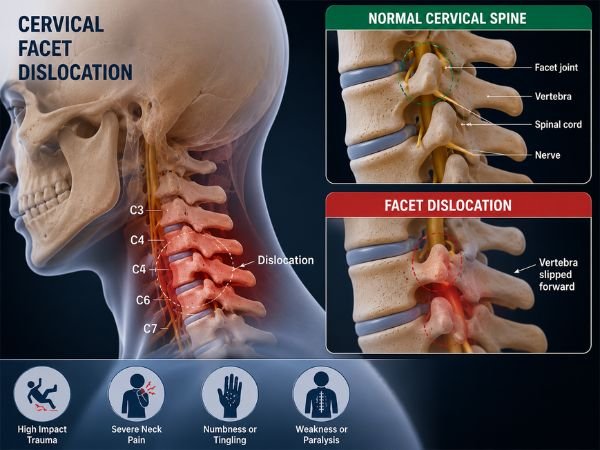
The seven vertebrae (C1–C7) that make up the cervical spine are joined by facet joints, which give the neck stability and smooth movement. When these joints are displaced by too much force, one vertebra slips over another, resulting in a cervical facet dislocation. (cervical spine)
This condition falls under one of the following categories:
- One side of the joint is affected by a unilateral facet dislocation.
- Both sides are affected by bilateral facet dislocation, which is frequently more severe and linked to spinal cord injuries.
Cervical Facet Dislocation Causes
High-energy trauma, such as the following, usually causes cervical facet dislocation:
- Traffic accidents on roads (head injury)
- Falls from a height
- Sports-related injuries, particularly in contact sports
- Abrupt, strong neck rotation or bending
The cervical spine rotates or hyperflexes as a result of such trauma, which might result in dislocation.
Cervical Facet Dislocation Symptoms
The severity of the injury and the extent to which the spinal cord is affected may determine the symptoms.
Typical Symptoms:
- Excruciating neck ache
- Restricted or uncomfortable neck movement
- Neck muscle spasms
Neurological symptoms (if nerves or the spinal cord are impacted):
- Arm or leg weakness
- Tingling or numbness
- Coordination loss
- Breathing difficulties (in severe situations)
- Paralysis (hemiplegia)
Note: Following trauma, every suspected neck injury should be handled as a medical emergency.
Cervical Facet Dislocation Diagnosis
Preventing complications requires a timely and precise diagnosis.
Methods of Diagnosis:
- X-rays: Preliminary imaging to identify alignment issues
- A CT scan can produce finely detailed pictures of bone structures. (O-Arm vs C-Arm Navigation in Spine Surgery)
- MRI: Examines soft tissues, ligaments, and the spinal cord
In order to evaluate nerve function, doctors also conduct a comprehensive neurological examination.
Cervical Facet Dislocation Treatment
The extent of severity the injury and whether the spinal cord is involved determine the course of treatment.
Stabilisation in an emergency
- Immobilisation with a brace or cervical collar
- Preventing any neck movement
Closed Reduction
- Realigning the displaced vertebrae without surgery
- Carried out under professional supervision using traction
Surgical Intervention
In extreme cases, surgery is frequently necessary, particularly when:
- Failure of closed reduction
- Spinal cord compression is present.
- The spine is not stable.
Typical Surgical Techniques:
- ACDF, or anterior cervical discectomy and fusion
- Fusion and posterior fixation
By using specialised implants to stabilise the spine, these operations aid in decompressing the spinal cord.
Healing and Rehabilitation
The degree of the injury and the method of therapy determine how well a patient recovers.
Important Recovery Aspects:
- Physiotherapy to regain mobility and strength
- Pain control
- Frequent consultation with the neurosurgeon
While severe cases involving spinal cord damage may necessitate long-term rehabilitation, patients with modest injuries may recover completely.
Cervical Facet Dislocation Complications
If left untreated, this illness may result in:
- Irreversible harm to the nerves
- Persistent neck discomfort
- Instability of the spine
- Paralysis
Results are greatly improved by early intervention.
When to Consult a Physician
Get medical help right away if you encounter:
- Damage to the neck following trauma
- Excruciating neck ache
- Numbness or weakness in the limbs
- Loss of control over the bowels or bladder
In conclusion
A cervical facet dislocation is a severe spine injury that needs to be treated by professionals right once. To ensure the best potential recovery, early diagnosis, appropriate treatment, and rehabilitation are essential.
Seeing a skilled neurosurgeon is crucial if you or a loved one has sustained a neck injury. Leading neurosurgeon Dr. Deepak Agrawal of AIIMS Delhi (AIIMS Appointments)specialises in advanced spine surgery and trauma care, providing innovative therapy for complicated spinal disorders.
FAQ’s
Is a cervical facet dislocation potentially fatal?
Indeed, it may be fatal, particularly if there is damage to the spinal cord. Getting medical attention right away is crucial.
Is surgery not necessary for cervical facet dislocation to heal?
While many cases need surgery for stability, mild cases can be treated without it.
How much time does it take to recover?
Depending on how serious the damage is, recovery can take a few weeks to several months.
After therapy, will I be able to move freely again?
Results vary depending on the degree of spinal cord involvement, although many patients make a full recovery.
After I recuperate, what safety measures should I take?
Stay away of excessive lifting, adhere to physiotherapy recommendations, and keep your neck in proper alignment.
Sources:
- https://pubmed.ncbi.nlm.nih.gov/35536995/
- https://pmc.ncbi.nlm.nih.gov/articles/PMC5846369/
- https://pubmed.ncbi.nlm.nih.gov/41207973/
- https://pubmed.ncbi.nlm.nih.gov/10616053/
- https://pubmed.ncbi.nlm.nih.gov/22184165/
- https://www.ncbi.nlm.nih.gov/books/NBK557528/
- https://pmc.ncbi.nlm.nih.gov/articles/PMC7870112/