Ventilators are life-saving tools used in contemporary critical care to assist patients who cannot breathe sufficiently on their own. The demand for portable, affordable, and intelligent ventilators has increased dramatically over the last ten years, particularly during emergency medical crises.
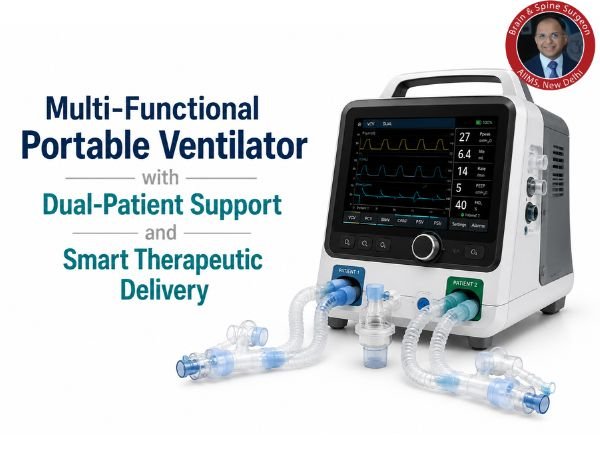
The multifunctional portable ventilator with dual-patient support and smart therapeutic delivery, a device intended to improve accessibility, efficiency, and patient outcomes, is one of the most promising breakthroughs.
Everything you need to know about this highly advanced ventilator is explained in this guide.
What is a Portable Ventilator?
A portable ventilator is a small, light device that helps patients breathe by supplying their lungs with oxygen-rich air. These devices, in contrast to conventional ICU ventilators, are intended for:
- Transport for emergencies (ambulances, field settings)
- In-home care
- Low-resource or rural healthcare settings
Depending on the demands of the patient, modern ventilators can provide controlled airflow utilising a variety of modes, such as volume-controlled or pressure-controlled ventilation. However, improper ventilation settings can sometimes lead to complications such as ventilator-induced lung injury, making advanced control systems essential.
Why Is This Ventilator “Multi-Functional”?
A multifunctional ventilator combines a number of innovative features into one apparatus:
Important Features
- Multiple ventilation modes, including regulated ventilation, BiPAP, and CPAP
- Integrated monitoring systems (airflow, oxygen levels, and pressure)
- Battery-operated and lightweight design
- Compatibility with ambient air and oxygen
These characteristics enable the device to be utilised in a variety of clinical situations, including long-term respiratory support and emergency care.
What Does Dual-Patient Support Mean?
This ventilator’s dual-patient support feature is among its most inventive features.
How It Operates
- Two patients can be supported continuously by a single ventilator.
- Each patient has their own flow as well as pressure controls in advanced systems.
- Sensors assist in tracking each person’s breathing habits.
Why It’s Important
Ventilator shortages can happen during emergencies (such as pandemics or natural disasters). Support for two patients can:
- With fewer resources, save more lives.
- Boost readiness for emergencies
- Maximise the capacity of the ICU
However, it’s crucial to remember that basic ventilator splitting can be dangerous if improperly managed because patients’ varying lung functions might alter the distribution of airflow. Innovative designs use separate monitoring and control systems to get around this.
Smart Therapeutic Delivery: The “Intelligence” Behind It
Modern ventilators are no longer merely mechanical devices—they are sophisticated systems.
Smart Features Include:
- AI-based adaptations to respiratory patterns
- Monitoring and notifications in real time
- Cloud connectivity for monitoring from a long distance
- Optimisation of automated oxygen delivery
Certain sophisticated ventilators have the ability to automatically modify pressure and airflow in response to patient needs, which lowers problems and enhances results.
Principal Advantages of This Technology
- Accessibility and Portability
- Transportable and lightweight
- Suitable for usage in disaster areas, rural clinics, and ambulances
- Economical Medical Care
- Lessens the requirement for several machines
- Perfect for environments with limited resources. Check out this market survey on hospital beds to understand broader hospital equipment needs.
- Better Patient Observation
- Tracking and alerting data in real time
- IoT-based remote monitoring
- Being Ready for Emergencies
- Helps several patients during emergencies
- Increases the capability for hospital surges. Smart integration like AI in trauma and emergency departments is transforming critical triage care.
Innovation at AIIMS and Its Role in India
Dr. Deepak Agrawal, a neurosurgeon at AIIMS Delhi, is credited with leading the way in the development of reasonably priced ventilator solutions in India. In critical cases, management follows strict clinical guidelines like those used for severe head injury management.
For instance, the AgVa ventilator is a small, inexpensive device that incorporates machine learning to adjust to the breathing patterns of patients and minimise difficulties. Advanced bio-tech research like brain organoids and medical engineering are driving such innovations.
These developments demonstrate how engineering, medicine, and technology may work together to enhance patient care on a large scale.
Restrictions and Safety Issues
These ventilators are promising, but they need to be utilised carefully:
- Strict monitoring is necessary for dual-patient ventilation.
- Not appropriate for every patient, particularly those with complex systemic conditions or traumatic endotheliopathy after brain injury.
- Needs qualified medical professionals.
In cases of critical illness, accurate assessment is vital—for example, distinguishing conditions in critical care setups such as coma vs brain death vs vegetative state. Safety continues to be the primary concern in every therapeutic context.
Future of Smart Ventilators
Ventilator technology is headed in the direction of:
- Completely autonomous AI-powered systems
- Customised ventilation techniques
- Telemedicine integration
- Longer battery life and improved portability
These developments are intended to improve the accessibility, effectiveness, and focus on patients of critical care.
Conclusion
A significant advancement in critical care technology is the multifunctional portable ventilator with dual-patient support and intelligent therapeutic delivery. It makes life-saving breathing support more accessible than ever before by fusing efficiency, intelligence, and portability.
Such technologies have the potential to revolutionise healthcare delivery, particularly in places with limited resources, with continuing innovation and careful clinical application.
Dr. Deepak Agrawal, a neurosurgeon at AIIMS Delhi, keeps advancing patient care and medical technology by bridging the gap between innovation and practical clinical demands.
Frequently Asked Questions (FAQs)
- Can two patients be safely supported by a single ventilator?Yes, but only with sophisticated technologies that enable autonomous control and monitoring. Unregulated simple splitting can be dangerous.
- What is a portable ventilator’s benefit?It makes it possible to provide life-saving breathing assistance outside of conventional intensive care units, such as in ambulances and remote locations.
- What does “smart therapeutic delivery” mean?It describes the intelligent, automated modification of airflow and oxygen according to the patient’s condition.
- Do people use these ventilators at home?Indeed, a lot of portable ventilators are made for at-home use, particularly for patients with long-term respiratory disorders.
- What distinguishes this from conventional ventilators?Modern portable ventilators are small, smart, and adaptable, whereas traditional ventilators are large and ICU-based.
- Does India have access to this technology?Indeed, India has created a number of affordable ventilator devices, including ones connected to AIIMS Delhi.