
Patients and their families frequently have questions and concerns about neurofibromatosis (NF), particularly in relation to genetics and heredity. This comprehensive guide explains what NF is, why it’s genetic, how it’s inherited, what it means for your family, and provides clear answers to frequently asked questions.
Neurofibromatosis: What Is It?
A collection of hereditary neurological disorders known as neurofibromatosis causes tumours to grow on nerves all over the body, including the brain, spinal cord, and peripheral nerves. Although these tumours are often benign (not malignant), depending on their size and location, they may occasionally cause problems.
Three main types of NF exist:
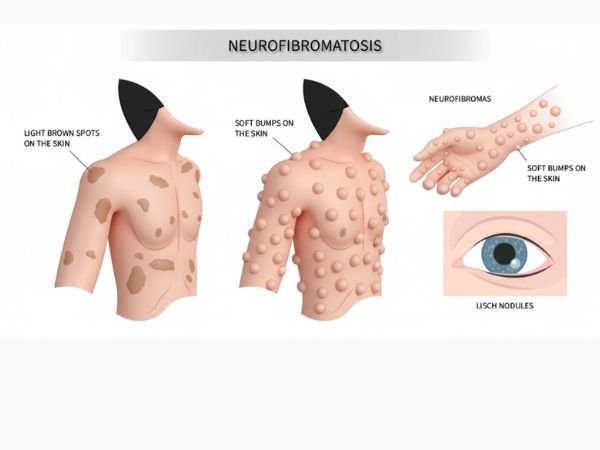
The most prevalent type is neurofibromatosis Type 1 (NF1).
Neurofibromatosis Type 2 (NF2) is a less common condition with distinct tumour characteristics.
The rarest type, Schwannomatosis, shares characteristics with NF but has different genetic causes.
What Makes Neurofibromatosis Genetic?
Yes, neurofibromatosis is inherited. This indicates that it results from alterations (mutations) in specific genes that often aid in controlling the proliferation of nerve tissue cells. Changes to these genes may cause cells to proliferate uncontrolled and develop tumours.
Important Genes Involved

Important Genes Involved Chromosome 17 contains the NF1 gene, which is mutated.
Chromosome 22 contains the NF2 gene, which is mutated.
The genes SMARCB1 and LZTR1 are linked to schwannomatosis.
How Does Neurofibromatosis Run in Families?
Dominant Autosomal Inheritance
The inheritance pattern for both NF1 and NF2 is autosomal dominant. This implies:

For the illness to manifest, a person only needs one mutated copy of the gene.
Each child has a 50% (1 in 2) chance of inheriting the faulty gene and, consequently, the condition if a parent has NF1 or NF2.
In certain situations, a person may have a mutation even if they don’t seem to have NF (known as “mosaic” forms). Because not every cell in a mosaic case has the mutation, diagnosis and inheritance patterns may become more complicated.
De Novo Mutations (Spontaneous)
It’s interesting to note that roughly half of NF1 and NF2 instances arise spontaneously (de novo), which means:
The condition is not present in either parent.
At conception, the sperm or egg undergoes a new genetic alteration.
There is still a 50% chance that the afflicted individual may pass the illness on to their offspring.
Does It Run in Families?
When an Individual Has NF
Parent Affected → Child:
There is a 50% probability that the child will inherit NF from each pregnancy.
Unaffected Parents → NF Child:
A de novo mutation is typically indicated by this.
Unless one parent has germline mosaicism—a uncommon condition in which some reproductive cells contain the mutation—the danger to the child’s siblings is typically minimal.
What Does Severity Mean in Terms of Genetics?
Severity might differ greatly even within the same family:
While one family member may have more tumours or difficulties, another may only have minor symptoms.
Variable expressivity is the term for this variance, which is prevalent in hereditary disorders such as NF.
Typical Symptoms and Signs
NF1
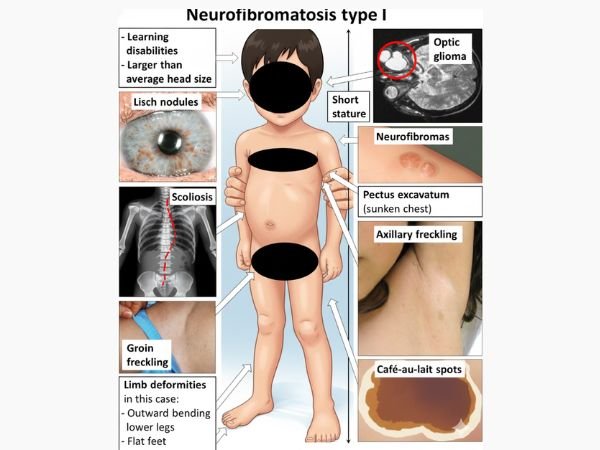
Several café-au-lait spots, or patches of light brown skin
Freckles in the groin or underarms
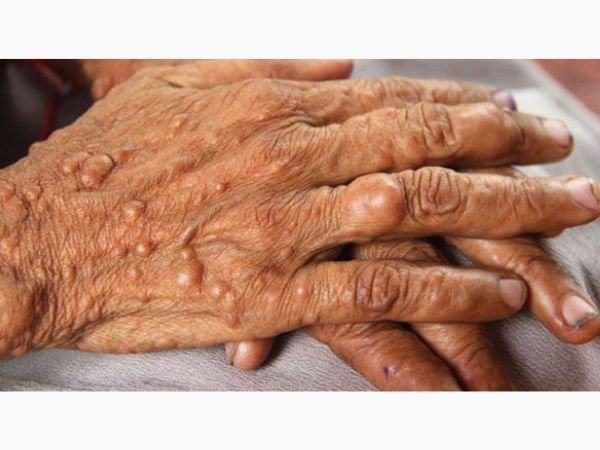
Small tumours on or beneath the skin are called neurofibromas.
Some people may have scoliosis, bone deformities, or learning disabilities.
NF2
Tumours along the auditory nerves, which can cause balance problems or hearing loss
Spinal tumours or meningiomas
Sometimes cataracts develop early.
Schwannomatosis
Painful schwannomas devoid of NF2’s characteristic vestibular tumours.
Genetic Testing and Counselling: An Important Step
If you or a family member has NF, or if there is a known family history of NF and you intend to become pregnant:
Genetic counselling is highly recommended.
Family planning and risk clarification are two benefits of genetic testing.
Synopsis
A inherited neurological disorder is called neurofibromatosis.
There is a 50% probability of passing it on if one parent has NF because it often follows autosomal dominant inheritance.
Many cases, even in the absence of a family history, are caused by spontaneous mutations.
Knowing genetics aids in family planning, care, and monitoring.
FAQ’s
1. Is it possible for NF to “skip” generations?
No. Because NF1 and NF2 are autosomal dominant, they do not “skip” or conceal themselves like recessive characteristics do. A person won’t carry the mutation or pass it on if they don’t inherit it.
What are a child’s chances if both parents have NF?
Genetic patterns become more complicated if both parents have NF1 or NF2, however each child may be at greater risk (typically up to 75% depending on combinations). Genetic counselling is advised.
Is it possible for a child to have NF if neither parent does?
Indeed, de novo mutations that are not present in parents account for nearly half of NF cases.
Is there a remedy?
Although there is currently no treatment, symptoms can be managed with routine monitoring and specialised care.
Sources
- https://www.ncbi.nlm.nih.gov/books/NBK459329/#_article-25785_s9_
- https://www.ncbi.nlm.nih.gov/books/NBK1109/
- https://pmc.ncbi.nlm.nih.gov/articles/PMC12075914/
- https://www.ninds.nih.gov/health-information/disorders/neurofibromatosis
- https://pubmed.ncbi.nlm.nih.gov/35121649/
- https://pmc.ncbi.nlm.nih.gov/articles/PMC6510158/
- https://pubmed.ncbi.nlm.nih.gov/26864895/
- https://pmc.ncbi.nlm.nih.gov/articles/PMC4918700/
- https://pubmed.ncbi.nlm.nih.gov/20301288/
- https://www.ncbi.nlm.nih.gov/books/NBK1109/?
- https://www.uab.edu/medicine/nfprogram/learn-about-nf/nf2/inheritance-genetics?
- https://www.genome.gov/Genetic-Disorders/Neurofibromatosis?