From minor traumas to serious brain damage, head traumas can vary widely. Diffuse Axonal Injury (DAI) is one of the most severe types of traumatic brain injury. It frequently poses a serious risk to life and requires treatment right away.
This guide provides straightforward explanations of diffuse axonal injury, including its causes, symptoms, diagnosis, available treatments, expected recovery, and frequently asked questions.
Diffuse Axonal Injury: What Is It?
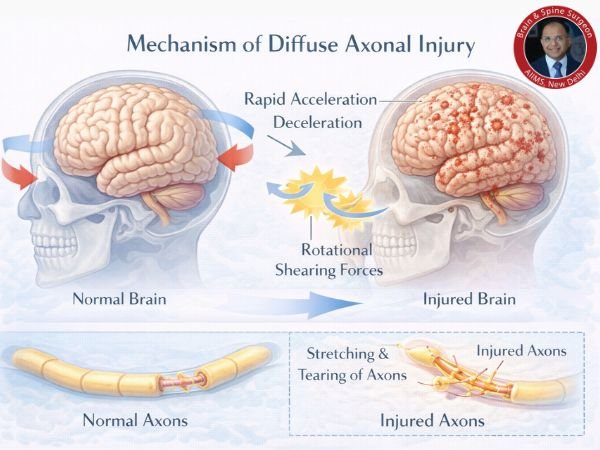
A severe brain injury known as diffuse axonal injury (DAI) is brought on by the head rapidly accelerating or decelerating, as happens during:
Traffic incidents on the roads
Drops from a height
Sports-related injuries
Physical attacks
Painful wounds
“Diffuse” indicates “widespread.”
The term “axonal” describes the lengthy nerve fibres that link brain cells and aid in signal transmission.
These sensitive nerve fibres are strained or ripped in DAI as a result of the brain’s abrupt rotation inside the skull. This can cause unconsciousness or a coma by interfering with brain cell communication.
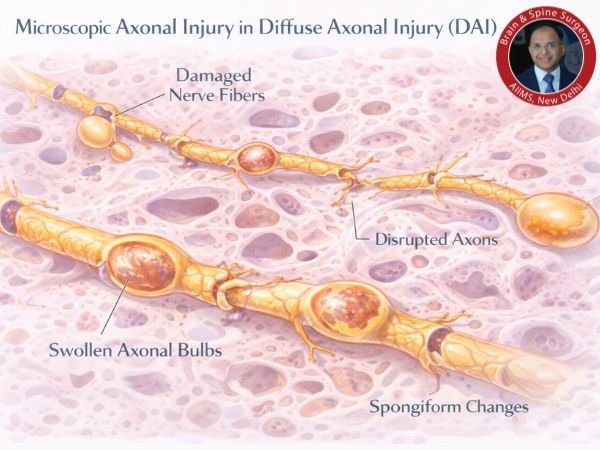
DAI may not necessarily exhibit significant bleeding on a CT scan, in contrast to certain other brain lesions, although microscopic damage may be widespread.
What Causes Diffuse Axonal Injury?
The soft brain rests in fluid within the skull. When the head abruptly moves:
The skull suddenly ceases.
For a little moment, the brain keeps moving.
Shearing forces result from this.
Axons can tear or stretch.
High-speed traffic accidents, one of the main causes of traumatic brain injury in India, frequently result in it.
DAI Types and Severity
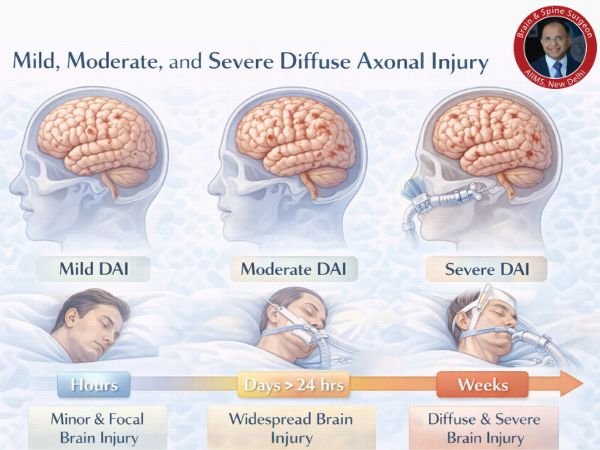
The severity of diffuse axonal injury determines its classification:
1. Mild DAI
Momentary unconsciousness
Disorientation or confusion
Symptoms that resemble concussions
2. Moderate DAI
Hours of unconsciousness
Deficiencies in the nervous system
Cognitive and memory problems
3. Severe DAI
Extended coma
Severe cerebral impairment
May result in permanent disability or a vegetative state.
Recovery results are mostly determined by the severity.
Diffuse Axonal Injury Symptoms
Depending on their severity, symptoms can include:
Symptoms Immediately
Unconsciousness
Chronic headache
Throwing up
Seizures
Pupils that are dilated
Breathing difficulties
Symptoms later on (should the patient recover consciousness)
Issues with memory
Having trouble focusing
Changes in mood
Changes in personality
Speech issues
Limb weakness
Inadequate coordination
Patients may be in a coma for a long time in severe instances.
How Do You Diagnose Diffuse Axonal Injury?
The diagnosis entails:
1. Clinical Assessment
Evaluation using the Glasgow Coma Scale (GCS)
Neurological assessment
Testing of responses from pupils
2. CT scan
Early on, it could seem typical.
Used to rule out significant bleeding
3. Brain MRI
More perceptive
Identifies minor axonal damage
Often confirms the diagnosis

Brain MRI comparison_ normal vs DAI
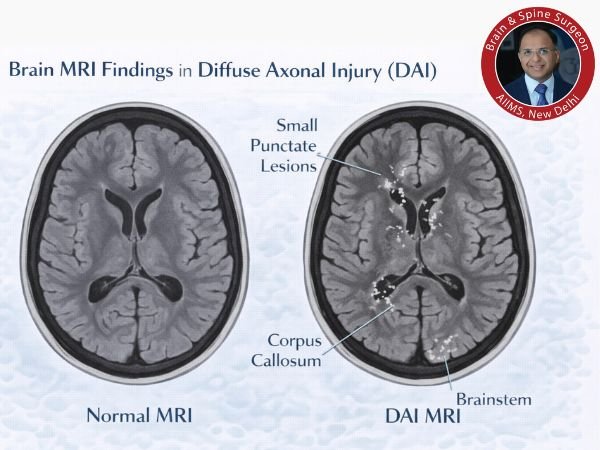
When the severity of symptoms does not correspond with the CT results, MRI is very crucial.
Managing Diffuse Axonal Injuries
Repairing damaged axons does not require specialised surgery. The focus of treatment is:
1. Stabilisation in an emergency
Keeping the oxygen supply constant
Managing blood pressure
Avoiding brain oedema
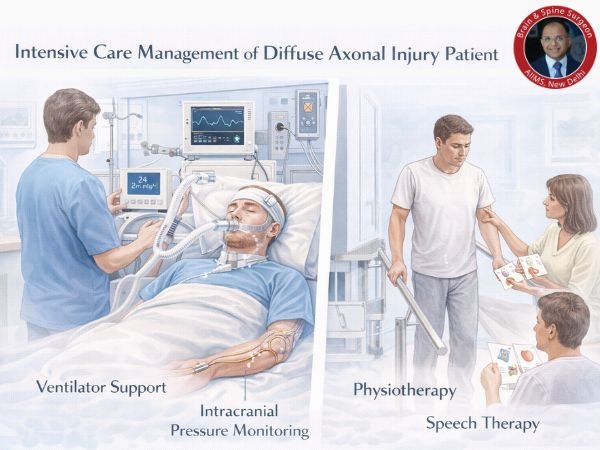
2. Care in the ICU
Support for a ventilator (if required)
Keeping an eye on intracranial pressure
Avoiding further brain damage
3. Drugs
To lessen oedema in the brain
Anti-seizures
Pain control
4. Rehabilitative
Structured therapy is crucial for recovery and includes:
Physiotherapy
Occupational therapy
Speech therapy
Neuropsychological treatment
Results are greatly improved by early rehabilitation.
Recuperation Following Diffuse Axonal Damage
Everybody recovers differently.
Affecting Recovery Factors:
Injury severity
Coma duration
Patient’s age
Medical treatment speed
Quality of rehabilitation
Potential Results:
Recuperation in full (rare in severe DAI)
Mild cognitive problems
Chronic disability
Long-term vegetative condition
Over the course of months or even years, some patients exhibit a slow improvement.
In order to rehabilitate, family support is essential.
DAI’s complications
Among the potential issues are:
Chronic cognitive decline
Having epilepsy
Modifications in behaviour
Paralysis or stiffness in the muscles
Issues with swallowing
Prolonged headaches
Disturbances in emotions
It is crucial to have regular follow-up appointments with a neurosurgeon and the rehabilitation staff.
Is It Possible to Prevent Diffuse Axonal Injury?
Risk can be decreased even though accidents cannot always be avoided by:
Helmet use when operating two-wheelers
Wearing seat belts
Preventing intoxicated driving
Putting up safety railings in senior citizens homes
Wearing protective clothing when playing sports
The best course of action is prevention.
When to Get Medical Help Right Away
Visit the emergency room right away if someone has:
Loss of consciousness due to a head injury
Frequent vomiting
Seizures
Severe headache
Perplexity or strange conduct
Weakness in the legs or arms
Prompt action can prevent complications and save lives.
FAQ’s
1. Are concussions and diffuse axonal injuries the same thing?
No. Concussions are typically mild and transient. DAI is more serious and involves brain nerve fibre structural damage.
2. Is it possible for someone to fully recover from DAI?
Severity determines recovery. In mild cases, recovery may be good. In severe cases, permanent impairment may ensue.
3. Does coma always result from DAI?
Not all the time. A mild DAI may knock you out for a short time. Prolonged coma is a common symptom of severe DAI.
4. Why does a CT scan appear normal in DAI at times?
Due to the extensive and microscopic damage. Axonal damage can be detected more sensitively by MRI.
5. How much time does it take to recover?
It could take months or years to recover. With therapy, some patients eventually get better.
6. Does DAI require surgery?
Axonal damage cannot be repaired surgically. Only when there is related bleeding or edema surgery is performed.
7. Can DAI result in irreversible brain damage?
Yes, particularly in extreme circumstances. The likelihood of a better outcome increases with early therapy.