When is Headache Dangerous?
One of the most prevalent health issues that people of all ages have is headaches. The majority of headaches are benign and transient, frequently brought on by stress, dehydration, or sleep deprivation. Nonetheless, a headache may occasionally indicate a dangerous underlying illness.

You can avoid complications and seek prompt medical attention if you know when a headache is dangerous.
A Headache: What is it?
Pain or discomfort in the head, neck, or scalp is referred to as a headache. Its source, frequency, and strength can all change.
Typical headache types include:
- Dull, pressure-like discomfort is known as a tension headache.
- Throbbing pain associated with migraine headaches, frequently accompanied by light sensitivity and nausea
- Severe discomfort surrounding one eye is known as a cluster headache.
- Sinus infections are linked to sinus headaches.
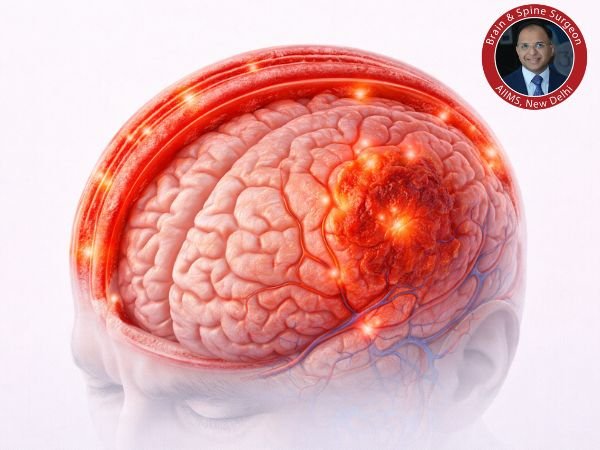
The majority of these headaches are primary, which means they are not brought on by another illness.
When Can a Headache Be Dangerous?
Although the majority of headaches are harmless, some signs could point to a secondary headache, which is brought on by an underlying illness and might need immediate medical attention.
Dangerous Headache Warning Signs
Get medical help right away if you encounter:
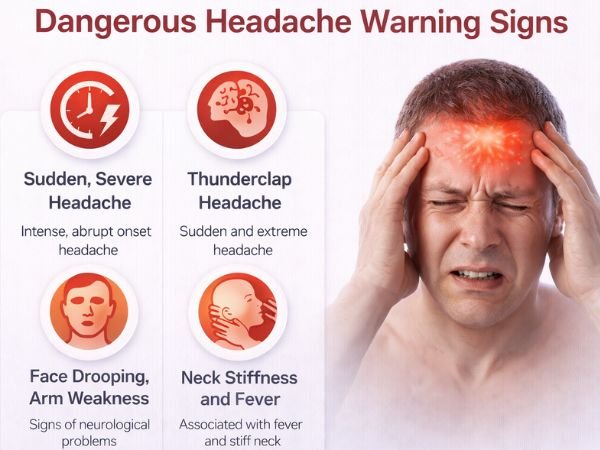
1. Sudden, Severe Headache (also known as “Thunderclap Headache”)
- Pain peaks in a matter of seconds
- The “worst headache of your life” is a common description.
- It might be a sign of a brain haemorrhage
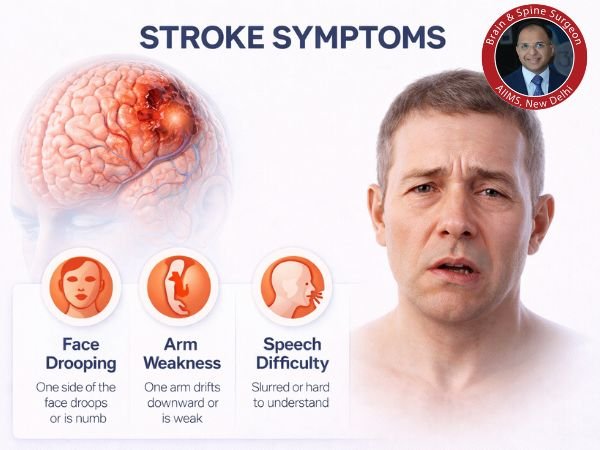
2. A headache accompanied by neurological symptoms
- Arm or leg weakness
- Speaking difficulties
- Vision issues
- Disorientation or unconsciousness
These could indicate a brain injury or stroke.
3. Headache Following a Head Trauma
- Particularly if things get worse over time.
- Connected to nausea or sleepiness
- Could be a sign of internal brain haemorrhage.
4. Chronic or Increasing Headache
- Growing in frequency or intensity
- Not alleviated by standard drugs
- May be connected to a long-term neurological disorder or brain tumour.
5. Fever, headache, and stiff neck
- In addition to light sensitivity
- Bending the neck is difficult.
Potential indication of brain infection (meningitis)
6. Vomiting with Headache (Without Nausea Cause)
- Vomiting, especially in the morning
- May indicate elevated intracranial pressure.
7. New Headaches in Senior Citizens (Over 50)
- Particularly if the onset is abrupt
- May be connected to vascular problems or temporal arteritis.
8. Headache Caused by Exercise
- Occurs when straining, coughing, or exercising.
- May point to deeper systemic issues.
Related Post: Understanding Headaches: Causes and Common Triggers
Reasons for Serious Headaches
Serious headaches could be brought on by:
- Brain haemorrhage, or brain bleeding
- A stroke
- Brain cancers
- Encephalitis or meningitis
- Hypertensive crises, or elevated blood pressure
- Brain damage caused by trauma
- Hydrocephalus, or the buildup of fluid in the brain
How Can a Dangerous Headache Be Identified?
A neurologist or neurosurgeon may suggest the following if a significant cause is suspected:
- CT scan of the brain to look for damage or bleeding
- MRI Brain: for precise imaging of tumours or anatomical problems
- Blood tests to look for inflammation or illnesses
- Spinal taps, or lumbar punctures, are used to diagnose illnesses such as meningitis.
For treatment to be effective, early diagnosis is essential.
Options for Treatment
The underlying cause determines the course of treatment:
- Drugs for migraines, inflammation, or infections
- Surgery for hydrocephalus, haemorrhage, or brain tumours
- Modifications to lifestyle: stress reduction, sleep, and hydration
- Emergency treatment for serious trauma or stroke
When Is It Time to See a Physician?
See a physician if you have:
- Headaches that interfere with day-to-day activities
- Medication-resistant headaches
- Unusual or novel headache patterns
- Any of the aforementioned warning indicators
Do not disregard severe or ongoing headaches. Early assessment has the potential to save lives.
Preventive Advice
Although it is not possible to avoid all serious headaches, you can lower your risk by:
- Maintaining Hydration
- Controlling tension
- Keeping up regular sleep schedules
- Steer clear of excessive screen time
- Regulating blood pressure
- Seeking prompt medical attention for wounds or infections
In conclusion
While the majority of headaches are benign, some may indicate more serious medical issues. Timely diagnosis and treatment of a serious headache depend on the ability to identify its warning signals.
Do not put off getting professional help if you or a loved one has uncommon or severe headache symptoms. Early action can save lives and avoid consequences.
FAQ’s
1. How can I determine whether my headache is severe?
Your headache may be dangerous and needs to be treated right away if it is sudden, intense, or accompanied by neurological symptoms (such as weakness, disorientation, or changes in vision).
2. What constitutes a “red flag” headache?
Symptoms of a red flag headache include abrupt onset, fever, neurological impairments, or increasing intensity; these could be signs of a serious underlying illness.
3. Can headaches be brought on by a brain tumour?
Indeed, brain tumours can produce headaches that develop over time and are frequently accompanied by seizures, vomiting, or eyesight issues.
4. If I have a headache, when should I visit the ER?
Proceed right away if you encounter:
The worst headache you’ve ever experienced
Headache with symptoms similar to a stroke
After a head injury, headache
Fever, headache, and stiff neck
5. Are migraines harmful?
Although severe or uncommon migraine patterns should be assessed to rule out other causes, migraines are typically not life-threatening.
Sources:
- https://pubmed.ncbi.nlm.nih.gov/18545910/
- https://pubmed.ncbi.nlm.nih.gov/2315244/
- https://pubmed.ncbi.nlm.nih.gov/29224432/
- https://www.ncbi.nlm.nih.gov/books/NBK554510/#_article-22610_s7_
- https://pubmed.ncbi.nlm.nih.gov/30346681/
- https://pubmed.ncbi.nlm.nih.gov/23939446/
- https://pubmed.ncbi.nlm.nih.gov/29789115/
- https://pmc.ncbi.nlm.nih.gov/articles/PMC9303246/