Imagine working in a hospital for several hours while wearing a protective suit with very limited ventilation. As time passes, heat and moisture begin to accumulate inside the suit. Healthcare workers may experience excessive sweating, fatigue and discomfort.
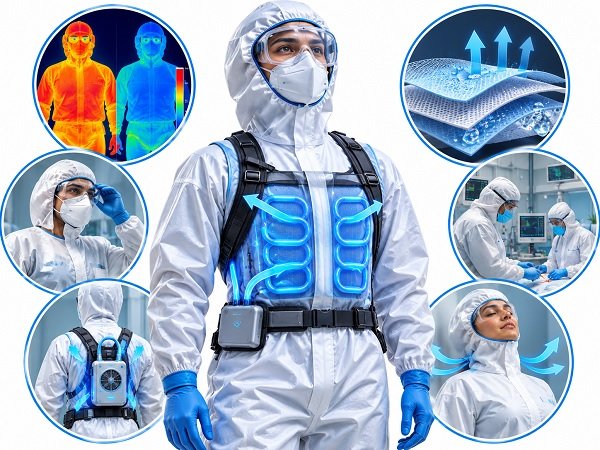
Why Does a Standard PPE Kit Generate Heat?
The human body constantly produces heat. Under normal conditions, sweating and the evaporation of sweat help regulate body temperature. Protective suits can restrict airflow and make it harder for sweat to evaporate. As a result, heat and moisture accumulate inside the garment.
Prolonged exposure to these conditions can lead to excessive sweating, fatigue, dehydration and heat-related illnesses. Therefore, protective clothing should take into account both external safety and the physical conditions of the wearer.
What Is Active Cooling Technology?
Active cooling uses external energy to remove heat from a particular space, surface or system. In wearable PPE, the aim is to manage temperature within the small space surrounding the body.
Depending on the engineering design, cooling may involve circulating chilled fluids or compact, electrically driven semiconductor cooling modules. The system should provide controlled cooling without restricting movement or compromising the protective performance of the equipment.
Several factors need to be considered during the development of such equipment:
- Temperature Regulation: Prevent local tissue cold injuries and excessive cooling or thermal shock.
- Weight and Balance: Avoid unnecessary physical strain on the wearer.
- Battery Safety: Assess battery capacity, electrical insulation and thermal runaway hazards.
- Hygiene: Allow appropriate cleaning and disinfection.
- Protective Integrity: Maintain the PPE barrier against infectious agents and bodily fluids.
Registered Design in India
A design titled Active Refrigeration and Thermal Personal Protective Equipment has been registered with the Patent Office of the Government of India.
The design registration details are provided below:
| Design Title | Active Refrigeration and Thermal Personal Protective Equipment |
|---|---|
| Design Registration Number | 508628-001 |
| Filing Date | July 8, 2026 |
| Grant Date | October 14, 2026 |
| Classification | Class 29-02 |
| Inventors/Holders | Dr. Deepak Agrawal and Venencia Albert |
This design addresses the discomfort healthcare professionals may experience when wearing protective clothing for extended periods. It explores the integration of active cooling while retaining the primary protective function of the garment.
Scientific clarification: Design registration establishes the legal recognition and protection of the registered design. It does not, by itself, demonstrate clinical efficacy, improved patient outcomes or long-term device safety. These aspects require separate technical testing and scientific evaluation.
Engineering Considerations Before Clinical Use
Developing wearable cooling equipment involves several engineering considerations. The following factors need careful assessment before any clinical or occupational application.
1. Weight Distribution
The cooling unit, battery and associated components add weight. Their positioning should not place excessive pressure on the back, shoulders or waist.
2. Power Supply and Operating Time
Battery capacity, electrical insulation, charging requirements and thermal runaway safety should be carefully evaluated to determine whether the equipment can operate reliably for its intended duration.
3. Temperature Control
Excessive cooling may cause discomfort, shivering or localized vasoconstriction. Temperature should therefore be maintained within appropriate limits.
4. Cleaning and Disinfection
Materials and electrical components should be compatible with appropriate hospital cleaning and disinfection procedures.
5. Movement and Ergonomics
The equipment should allow healthcare professionals to walk, bend, examine patients and perform procedures without unnecessary restrictions.
Potential Applications
Infectious Disease Units
Healthcare workers in isolation facilities may need to wear protective clothing for extended periods. Temperature management could be useful in such environments.
Biomedical Research Laboratories
Wearable cooling systems may have potential applications in specialized laboratories and cleanrooms where protective clothing is required.
Emergency Medical Services
Emergency response personnel sometimes work outdoors or in environments with extreme temperatures. Thermal management may be worth exploring in protective equipment designed for these conditions.
Industrial Occupational Safety
Similar engineering principles could be investigated for protective equipment used in construction, manufacturing and other high-temperature workplaces.
These are potential applications rather than established indications. Each environment requires a separate technical assessment, safety evaluation and real-world testing before the equipment can be considered suitable for routine use.
Why Healthcare Worker Comfort Matters
Patient care remains a primary goal of healthcare. However, the working conditions of doctors, nurses and other medical professionals also deserve attention.
Healthcare workers often perform demanding duties while wearing protective equipment for prolonged periods. Excessive heat and physical discomfort can make these working conditions more difficult.
Technologies that can help manage thermal discomfort while maintaining appropriate protective standards deserve further engineering and scientific investigation. Their safety, performance and practical benefits must be established through suitable evaluation.
Frequently Asked Questions
1. What is Active Refrigeration and Thermal Personal Protective Equipment?
It is a registered design concept that incorporates an active cooling mechanism into personal protective equipment to help manage heat-related discomfort.
2. Why does heat accumulate inside a PPE suit?
Protective suits can restrict airflow and reduce sweat evaporation. This can cause heat and moisture to accumulate inside the garment.
3. How does active cooling technology work?
Active cooling uses external energy to remove heat. Depending on the engineering configuration, it may involve circulating chilled fluids or electrically driven semiconductor cooling modules.
4. What is the design registration number?
The Design Registration Number is 508628-001, registered under Class 29-02.
5. Who are the inventors or holders of the registered design?
The names supplied for the design are Dr. Deepak Agrawal and Venencia Albert. Please verify the second name against the official certificate before publication.
6. Does design registration establish clinical effectiveness?
No. Design registration provides legal protection for the registered design. Clinical effectiveness, safety and health-related benefits require separate technical testing and scientific evaluation.
7. Where could active cooling PPE be used?
Potential applications include infectious disease units, biomedical research laboratories, emergency medical services and industrial workplaces. Each application requires separate testing and safety assessment.