Can Blood Tests Predict Brain Changes After Gamma Knife? Role of VEGF & Endostatin in AVM Patients

Overview
Complex vascular disorders in the brain known as arteriovenous malformations (AVMs) can result in major side effects, such as bleeding. Gamma Knife radiosurgery, a precise, non-invasive procedure that targets faulty blood arteries, is one of the most cutting-edge treatments available today.
However, a crucial query still needs to be answered:
Can we forecast the brain’s reaction to Gamma Knife therapy?
According to recent studies, blood-based biomarkers like endostatin and VEGF may provide important information about how well a treatment is working and how the brain changes following radiosurgery.
This site provides clear explanations of all you need to know.
An Arteriovenous Malformation (AVM): What is it?
An AVM is a network of aberrant blood vessels that connect the brain’s arteries and veins. This interferes with the regular circulation of oxygen and blood.
Related Post:
Important AVM Risks:
- Bleeding (brain haemorrhage)
- Seizures
- Headaches
- Neurological deficiencies
Gamma Knife Radiosurgery: What is it?
AVMs and other brain disorders are treated with Gamma Knife, an extremely accurate type of radiation therapy.

How it operates
- Abnormal vessels are the target of focused radiation beams.
- Causes these capillaries to gradually thicken and close.
- Lowers the chance of bleeding over time
Crucial Information:
The AVM may take months or years to fully close, thus the results are not instantaneous.
The Significance of Monitoring Following Gamma Knife
Following treatment, physicians must keep an eye on:
- AVM closure (obliteration)
- Changes in the brain caused by radiation
- Risk of complications or swelling
At the moment, monitoring entails:
- MRIs
- CT scans
- Clinical assessment
But these techniques:
- Are costly
- Need to visit the hospital frequently
- Not able to identify early molecular alterations
👉 blood tests predict brain changes after Gamma Knife — Blood tests could be revolutionary in this situation.
Biomarkers: What Are They?
Measurable chemicals in the body that reveal a biological activity or disease state are known as biomarkers.
Certain blood indicators in AVM patients may show:
- Development of blood vessels
- Healing reaction
- Effects of radiation
Two important biomarkers under investigation are:
- Vascular endothelial growth factor, or VEGF
- Endostatin
VEGF’s Function in AVM Patients
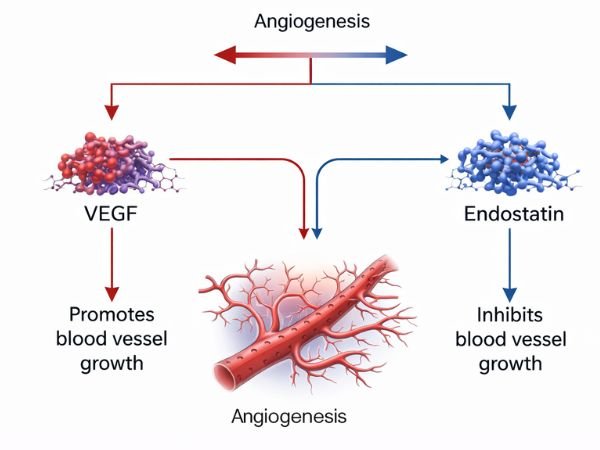
A molecule called VEGF encourages the development of new blood vessels.
Why it’s important
Abnormal vascular growth is linked to AVMs.
VEGF levels could rise in reaction to:
- Low oxygen, or hypoxia
- Radiation damage
- Healing procedures
Following the Gamma Knife:
Increased VEGF could be a sign of continued vascular activity.
It could be related to:
- AVM closure that is delayed
- Risk of alterations brought on by radiation
Endostatin’s Function in AVM Patients
A naturally occurring inhibitor of blood vessel development is endostatin.
Why it’s important
It inhibits VEGF
Aids in controlling aberrant angiogenesis, or the development of vessels
Following the Gamma Knife:
Elevated endostatin levels could indicate:
- Improved response to therapy
- Inhibition of aberrant vascular development
Comprehending the Balance Between VEGF and Endostatin
Endostatin and VEGF have a vital interaction.
| A factor | Function | Clinical Importance |
|---|---|---|
| VEGF | Encourages the development of blood vessels | May show a radiation reaction or an active AVM. |
| Endostatin | Prevents the development of vessels | May be a sign of recovery and successful therapy |
Can Brain Changes Following Gamma Knife Be Predicted by Blood Tests?
Present Knowledge:
According to research,
Variations in endostatin and VEGF levels may be indicative of brain biological activity.
These indicators might be useful:
- Forecast the outcome of treatment
- Identify the early impacts of radiation
- Track the development of AVM
Possible Advantages:
- Non-invasive observation
- Early identification of issues
- Tailored treatment strategy
- Decreased frequency of imaging
Restrictions
- Research is ongoing
- Not yet a common clinical procedure
- Patients may experience different outcomes
AVM Monitoring’s Future: A Transition to Precision Medicine
AVM treatment could be completely transformed by combining blood biomarkers with imaging methods.
In the future, physicians might:
- To monitor recovery, use basic blood tests
- More precisely predict results
- Adapt therapies to each patient’s unique biology
This method is consistent with accuracy and customised neurosurgery.
Important takeaways
- For AVMs, Gamma Knife is a very successful non-invasive treatment.
- Currently, imaging is used to monitor treatment response, which is essential.
- Blood biomarkers that show potential for predicting changes in the brain include endostatin and VEGF.
- Early detection, improved monitoring, and individualised care may be made possible by these markers.
- Before they are used as conventional clinical tools, more research is required.
In conclusion
It is intriguing and encouraging to think that a straightforward blood test could forecast changes in the brain following Gamma Knife therapy. Although they are currently in the research stage, biomarkers like as VEGF and Endostatin provide a window into the less intrusive, more accurate, and highly customised neurosurgical care of the future.
See a neurosurgeon to determine the most appropriate monitoring plan for your condition if you or a loved one is receiving treatment for AVM.
FAQ’s
1. After Gamma Knife, can a blood test take the place of an MRI?
No. Blood tests cannot yet take the role of imaging because they are still in the research stage. In the future, they might supplement scans.
2. How frequently should AVM patients be observed following Gamma Knife?
Generally speaking:
- Every six to twelve months, MRI scans
- The length of the follow-up could be many years
3. Are tests for endostatin and VEGF generally accessible?
As of yet, clinical practice does not frequently employ these assays for AVM monitoring.
4. Can problems be predicted by these biomarkers?
Further study is required to verify their prediction accuracy, however they might be useful in identifying early biological alterations.
5. Can AVM be permanently cured with Gamma Knife?
Yes, most of the time, although it depends on:
- AVM location and size
- Factors unique to each patient
- Total destruction might take time
Sources: