One of the biggest causes of disability and mortality in the globe is still traumatic brain injury (TBI). Understanding how the brain heals or fails to heal after injury remains a significant scientific problem despite advancements in neurosurgery and critical care.
Researchers’ understanding of brain damage is currently being revolutionised by a ground-breaking advancement in organoid brain research. These lab-grown miniature brains, referred to as brain organoids, are paving the way for new developments in medication development, brain repair technology, and TBI study models.
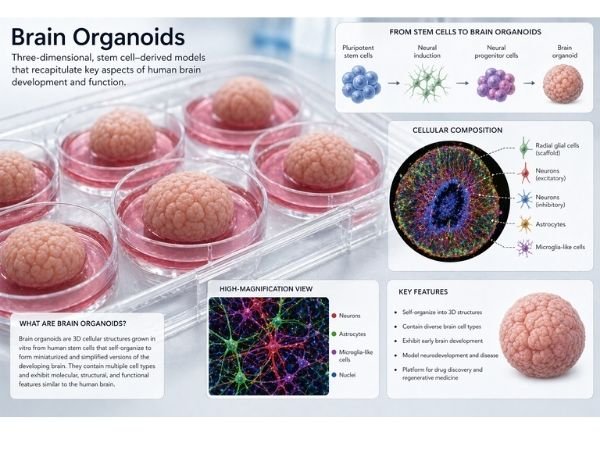
However, what are brain organoids exactly, and how may people with brain damage benefit from them? Let’s have a look.
Brain Organoids: What Are They?
Brain Organoids in Traumatic Brain Injury Research are three-dimensional miniature replicas of the human brain that are developed using stem cells in a lab. These structures replicate important features of actual human brain tissue, such as:
- Brain cells, or neurones
- Neural networks
- Fundamental architecture of the brain
Organoids behave more like real human brain tissue than conventional 2D cell cultures, which makes them extremely useful for study.
Related Post: Carotid Artery Injuries in Traumatic Brain Injury
Why Do Brain Organoids Matter for TBI Research?
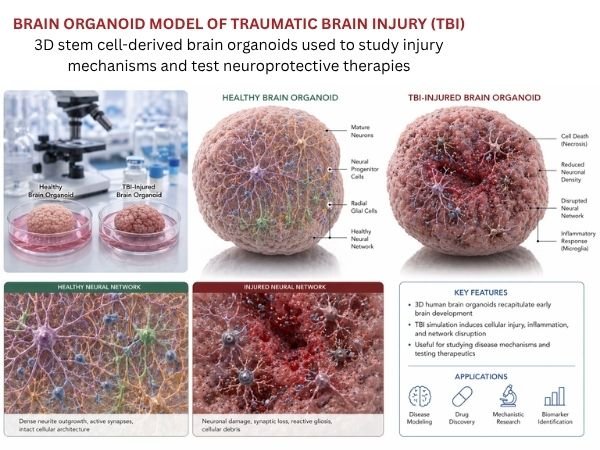
Simplified cell cultures or animal studies are major components of traditional TBI research models. These models are helpful, but they have drawbacks:
- The brains of animals and humans are not the same.
- Complex brain anatomy is absent from 2D cultures.
- Replicating actual damage patterns is difficult.
These difficulties are addressed by Brain Organoids in Traumatic Brain Injury Research, which offer a controlled, human-like setting for researching damage mechanisms.
Principal Benefits
- Mimic the growth and reaction of the human brain
- Permit accurate injury simulation
- Utilise patient-derived cells to enable customised research
How Traumatic Brain Injury Research Uses Brain Organoids
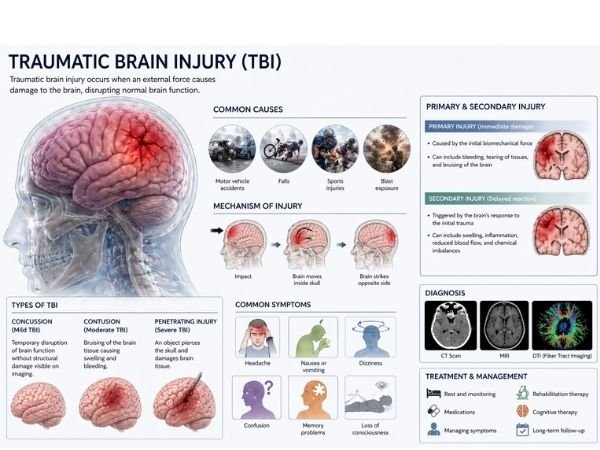
1. Researching the Mechanisms of Brain Injury
In organoids, researchers can mimic trauma to see:
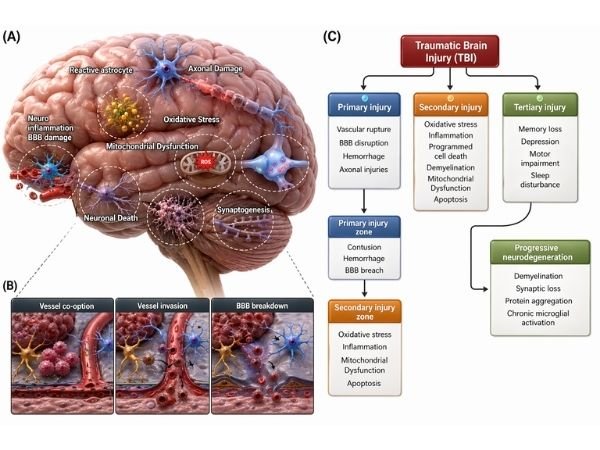
- Damage to neurones
- An inflammatory response
- Pathways leading to cell death
This makes it easier to understand what precisely occurs within the brain following an injury.
2. Examining Unique or New Approaches
Research on stem cell brain injury treatment is being revolutionised by Brain Organoids in Traumatic Brain Injury Research because they allow:
- Drug testing on brain tissue similar to that of humans
- Assessment of neuroprotective treatments
- Finding substances that aid in healing
3. Customised Healthcare
Scientists are able to produce patient-specific brain organoids using stem cells from individual patients. This permits:
- Tailored therapy evaluation
- Improved forecasting of treatment results
- Decreased trial-and-error in treatment
4. Modelling TBI’s Long-Term Effects
Brain organoids are useful for researching long-term issues like:
- Neurodegeneration
- Cognitive deterioration
- Traumatic epilepsy
Improving long-term patient care depends on this.
Stem Cells’ Function in Brain Repair
Research on stem cell therapy for brain injury is at the core of organoid technology.
The special capacity of stem cells is to:
- Change into multiple types of brain cells
- Replacing injured neurones
- Encourage regeneration
Brain Organoids in Traumatic Brain Injury Research speed up the development of regenerative medicines by enabling researchers to examine how stem cells function in damaged brain-like settings.
Related Post: Development of Brain Organoids
Brain Repair Technology’s Future
The future of neurosurgery and rehabilitation is being shaped by the merging of Brain Organoids in Traumatic Brain Injury Research, traumatic brain injury research, and cutting-edge technology like bioengineering and artificial intelligence.
New Opportunities:
- Brain tissue produced in a lab for transplanting
- Drug development powered by AI with organoid data
- Precision medicine for individuals with brain injuries
- Early identification of issues
Even though they are still in their beginning stages, these developments mark a significant advancement in the field of functional brain repair.
Brain Organoids’ Limitations
Brain organoids are not flawless, despite their potential.
Present Difficulties:
- Insufficient brain complexity
- Absence of blood flow (vascular system)
- Restricted capacity to reproduce whole-brain interactions
- Advanced development’s ethical issues
However, these limitations are still being addressed by continuing research.
Clinical Impact: Patient’s Outcomes
This study may result in the following outcomes for traumatic brain injury patients:
- Quicker development of comparatively efficient therapies
- Less post-injury complications
- More individualised treatment regimens
- Better results from rehabilitation
Brain organoids are quickly transitioning from lab research to practical applications, although not yet being extensively utilised in clinical practice.
Conclusion
An important turning point in neuroscience has been the development of organoid brain research. Brain Organoids in Traumatic Brain Injury Research are revolutionising our understanding of and approach to treating traumatic brain injury by bridging the gap between laboratory models and actual human brain activity.
The combination of brain organoids, traumatic brain injury models, stem cell therapy, and AI-driven insights holds great potential for the future of brain repair technology as research progresses, offering hope to millions of people affected by brain injuries worldwide.
FAQ’s
To put it simply, what are brain organoids?
Brain organoids are miniature, stem cell-based replicas of the human brain. They aid researchers in the study of brain injuries and illnesses.
What role do brain organoids play in the study of traumatic brain injury?
They serve as sophisticated models for TBI research, enabling scientists to replicate brain damage and evaluate therapies in a setting similar to that of a human.
Is it possible to treat patients directly with brain organoids?
These days, research is the primary purpose for them. They might, however, aid in the development of regenerative medicine and brain repair technology in the future.
How do stem cells fit into the therapy of brain injuries?
Stem cells may aid in tissue repair and can differentiate into brain cells. Treatment approaches for brain injury utilising stem cells are being advanced by research employing organoids.
Are animal models inferior to brain organoids?
They enhance the accuracy of study findings by supplementing animal studies with human-specific knowledge.
Do hospitals currently have access to this technology?
Although it is not now used for routine treatment, it is developing quickly and could be included in clinical care in the future.