
This article is based on an educational medical discussion by Dr. Deepak Agrawal, Professor of Neurosurgery at AIIMS New Delhi, where he clearly explains these conditions in simple language for the general public.
What Is Coma?
Any condition in which a patient is not conscious and cannot be awakened is broadly referred to as coma.

A patient in coma:
- Does not respond to sound or pain
- Has no awareness of surroundings
- Cannot be awakened
Coma can be temporary or prolonged. Some patients regain consciousness within days or weeks, while others may progress to more severe neurological states.
Causes of Coma
Coma can result from any condition that disrupts normal brain function, including:
- Road traffic accidents and head injuries
- Chemical poisoning or drug overdose
- Stroke or brain hemorrhage
- Severe infections
- Oxygen deprivation
- Metabolic disorders
If coma persists for a long duration, it may progress to a vegetative state. If brain function stops completely and irreversibly, it results in brain death.
What Happens Inside the Brain During Coma?
Coma is different from sleep. During sleep, the brain passes through various stages such as light sleep, deep sleep, and REM sleep. In coma, the brain is suppressed beyond deep sleep.
During surgery, anesthetic drugs intentionally induce a coma-like state, demonstrating how deeply brain activity can be suppressed.
Role of the Reticular Activating System (RAS)
The Reticular Activating System (RAS) is a critical brain network responsible for maintaining consciousness.
When the RAS is:
- Damaged
- Chemically suppressed
- Structurally disrupted
A person may enter a coma — a state of very deep unconsciousness from which they cannot be awakened.
What Is a Vegetative State?

A vegetative state is diagnosed when a patient has been in coma for a prolonged period and the chances of regaining consciousness are almost zero.
Diagnostic Time Criteria
Medical guidelines vary:
- United States: 3 months of coma
- Many other countries: 6 months of coma
All reversible causes must be excluded before labeling a patient as being in a vegetative state.
Clinical Features
Patients in a vegetative state may:
- Open their eyes
- Swallow food
- Breathe on their own
However, they:
- Do not respond to commands
- Do not communicate
- Show no awareness
- Do not focus or track visually
They may appear awake but are not conscious. This is why the term vegetative is used.
Prognosis
- Patients can remain in this state for 20–30 years
- Recovery after traumatic brain injury is extremely rare
- Slightly better outcomes may occur in poisoning or stroke cases
- There is no definitive curative treatment, only supportive care
Can Someone Wake Up Suddenly from Coma?
Movies often portray patients waking up suddenly from coma and becoming completely normal. This is medically inaccurate.
In real clinical practice:
- Sudden complete recovery is extremely rare
- Most patients have lasting cognitive or physical deficits
- Recovery depends on whether the cause was reversible
What Is Brain Death?
Brain death is entirely different from coma and vegetative state.
Brain death means:
- Complete and irreversible cessation of brain function
- No chance of recovery
- The patient is legally and medically dead
The heart may continue beating only due to ventilator support.
Clinical Features of Brain Death
- No spontaneous breathing
- No brainstem reflexes
- Possible spinal reflexes (not brain activity)
In India, brain death is diagnosed using strict clinical criteria and is legally recognized as death. This stage is crucial for organ donation, with family consent.
Importantly, no laboratory test is mandatory — diagnosis is purely clinical.
How Are These Conditions Diagnosed?
Identifying the Cause
Doctors use:
- Detailed medical history
- CT scan or MRI
- Blood investigations
- Toxicology screening
Glasgow Coma Scale (GCS)
The Glasgow Coma Scale evaluates:
- Eye response
- Verbal response
- Motor response
Scores range from 3 to 15:
- 15 – Normal consciousness
- ≤8 – Severe coma
- 3 – Deep coma, near brain death
GCS remains the gold standard for clinical assessment and prognosis.
Comparison Table: Coma vs Vegetative State vs Brain Death
| Feature | Coma | Vegetative State | Brain Death |
| Consciousness | Absent | Absent | Absent |
| Eye Opening | No | Yes | No |
| Response to Commands | No | No | No |
| Spontaneous Breathing | May or may not | Yes | No |
| Brain Function | Impaired | Severely damaged | Completely stopped |
| Duration | Days to weeks | Months to years | Permanent |
| Chance of Recovery | Possible | Extremely rare | None |
| Legal Status | Alive | Alive | Dead |
| Organ Donation | Not applicable | Not applicable | Possible |
FAQs – People Also Ask (PAA)a
What is the difference between coma and brain death?
Coma is a state of unconsciousness where recovery may still be possible. Brain death is the irreversible loss of all brain functions and is legally considered death.
Can vegetative state patients recover?
Recovery is extremely rare, especially after traumatic brain injury. Some improvement has been reported in non-traumatic causes such as poisoning or stroke.
Do vegetative state patients open their eyes?
Yes, they may open their eyes and swallow food, but they have no awareness or meaningful responses.
Is eye opening a sign of improvement?
No. Eye opening does not indicate recovery in vegetative state patients.
Can coma patients wake up suddenly?
Sudden complete recovery is rare. Recovery depends on whether the underlying cause is reversible.
What is the Glasgow Coma Scale used for?
It is used to assess the level of consciousness and predict outcomes in coma patients.
Why is brain death important for organ donation?
Organ donation is only possible after brain death because organs remain viable with ventilator support.
Many people are both fascinated and afraid of the medical condition known as a coma. Families are frequently overcome with anxiety, uncertainty, and optimism when a loved one falls into a coma. This site is to provide compassionate and understandable explanations of what a coma is, how recovery proceeds, the variables affecting results, and answers to commonly asked concerns.

A Coma: What is it?
A coma is a severe unconsciousness in which a person:
Fails to awaken
Does not react to touch or sounds
Unable to follow instructions or communicate
It is not sleep because the person cannot be awakened by typical signs and the brain is not going through the stages of sleep.

Comas are caused by severe diseases or injuries that impair brain function. Among the most typical causes are:
Traumatic Brain Injury (TBI) (such as falls and auto accidents)
Stroke, particularly when a significant portion of the brain is affected
Infections of the brain (such as encephalitis and meningitis)
Oxygen deprivation of the brain (such as cardiac arrest)
Metabolic or toxic disorders (e.g., medications, severe diabetes)
How Comas Are Evaluated
Medical professionals use the Glasgow Coma Scale (GCS) to evaluate the degree of coma depending on:
Opening of the eyes
Verbal reply
Reaction of the motor
The range of scores is 3 (deep coma) to 15 (totally alert). More severe brain impairment is indicated by lower scores.
Advanced studies that help identify the cause and evaluate damage include CT scans, MRIs, EEGs, and blood tests.
Can Someone Get Out of a Coma?
Indeed, many people do recover; however, their level and pace of recovery differ greatly. The healing process is a spectrum:
Potential Outcomes
| Outcome | Description |
|---|---|
| Complete Rehabilitation | Return to your prior working level |
| Partial Rehabilitation | There is still some disability (speech, cognitive, and physical). |
| Vegetative state | Awake but clueless about the surroundings |
| Minimally Conscious State | Displays unpredictable but thoughtful reactions |
| Death | Severe injury results in irreversible outcomes. |
Age, severity, cause of illness, and care received all affect recovery.
Recovery Stages
Following a coma, many patients exhibit this pattern:
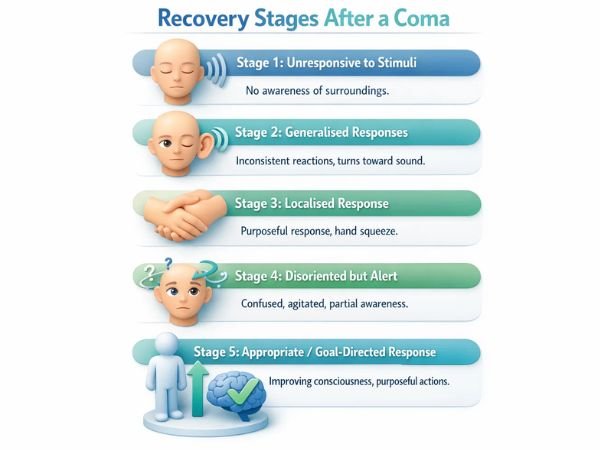
Unresponsive to Stimuli: Not conscious of oneself or one’s surroundings.
Generalised responses: Inconsistent behaviours, such as directing one’s gaze towards a sound.
Localised response: Squeeze hand is an example.
Disoriented but more alert: confused or agitated.
Appropriate/Goal-directed: Improving consciousness and performance.
Not everyone experiences all stages.
Important Elements That Determine the Result
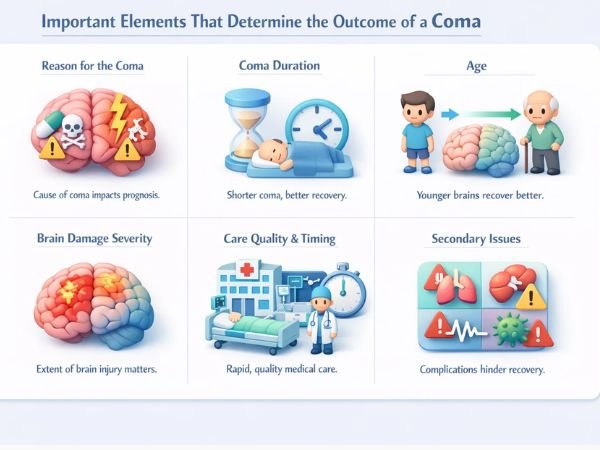
1. The reason for the coma
Early treatment often improves the prognosis of metabolic or toxin-related comas.
A coma brought on by a major stroke or brain injury may increase the likelihood of neurological damage.
2. Coma Duration
Better recovery is typically determined by shorter comas.
3. Age
Because of brain plasticity, younger people typically recover more quickly.
4. Brain Damage Severity
The location and severity of the injury are important; more extensive and deep damage reduces the likelihood of a full recovery.
5. Care Quality and Timing
Prognosis is improved by prompt and adequate intensive care, neurosurgery procedures where necessary, and rehabilitation.
6. Secondary Issues
Recovery may be hampered by organ failure, swelling, seizures, and infections.
How Does Recovery Get Help?
Waking up from a coma is only one aspect of recovery; rehabilitation is another.
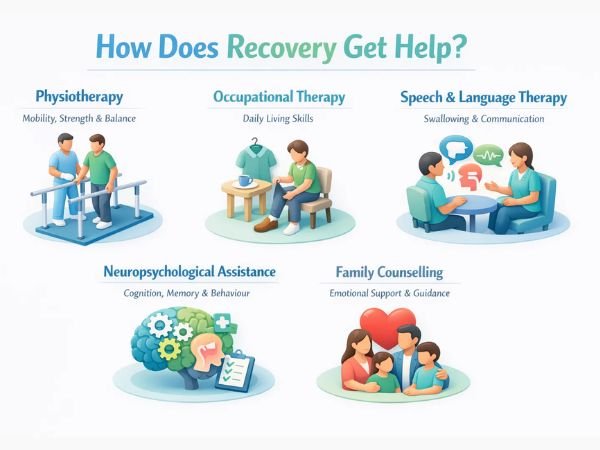
Physiotherapy: mobility, strength, and balance
Occupational Therapy: Everyday Life Skills
Speech and Language Therapy: Swallowing and Communication
Neuropsychological Assistance: Cognition, Memory, and Behaviour
Family counselling: advice and emotional support
Plans for rehabilitation are customised and can last for months or even years.
Common Myths Regarding Comas
Myth: People in a coma can hear everything around them.
Fact: There may be some awareness, but it varies greatly.
Myth: A head injury always results in a prolonged coma
Fact: Most head injuries do not induce a long-term coma.
Myth: People who don’t wake up immediately will never wake up.
Fact: Different people recover at different times; some people wake up after many weeks.
Indications of Enhanced Brain Performance
Opening the eyelids to touch or sound
Observing basic instructions
Speaking or making a significant movement
Looking in the direction of familiar noises
Emotional reactions
Every milestone, regardless of size, is important.
When to Talk About the Prognosis
Discussions about prognoses are intricate and personal. Physicians take into account:
Clinical examinations
Imaging results
Timeline and cause
Reaction to therapy
The prognosis is dynamic and subject to alteration over time.
In Conclusion
Although coma is a severe, life-altering illness, many people can recover and resume meaningful functioning. Each person’s journey is unique and is influenced by time, care, and circumstance.
Expert rehabilitation, family support, and compassionate care have a significant impact at every stage.
Please get in touch with our team if you or a loved one is going through this journey; we are available to help, support, and respond to your enquiries.
FAQ’s
1. What is the maximum duration of a coma?
The length of a coma might vary from a few days to several weeks. Comas lasting more than a month are uncommon.
2. Does a person in a coma experience pain?
Pain perception may be diminished if brain networks for feeling are compromised. Reflexive reactions are still possible, though.
3. Can family visits be beneficial?
Indeed. Recovery may be aided by familiar voices, touch, music, and images that excite the brain.
4. What distinguishes a vegetative state from a coma?
Coma: Not awake or conscious.
Vegetative state: There is no awareness of the environment, but eyes open periodically.
5. Can someone be awakened from a coma with medication?
There isn’t a “coma cure,” however certain medications are employed in specific situations. Treatment focusses on the underlying causes.
Sources:
- https://journalonsurgery.org/articles/js-v3-1120.html
- https://theconversation.com/why-are-patients-in-permanent-comas-routinely-kept-alive-43365
- https://brainfoundation.org.au/disorders/coma/
- https://pmc.ncbi.nlm.nih.gov/articles/PMC4704482/
- https://pmc.ncbi.nlm.nih.gov/articles/PMC8382106/
- https://pubmed.ncbi.nlm.nih.gov/15986756/
- https://pmc.ncbi.nlm.nih.gov/articles/PMC4771229/