Skip to content

Gamma Knife for Giant Brain Tumors: Can Large Tumors Be Treated Without Surgery?

Topics

Table of Contents

It might be devastating to learn that you have a massive brain tumour. Large tumours have historically necessitated open brain surgery, which entails risks like haemorrhage, infection, and a protracted recuperation period.
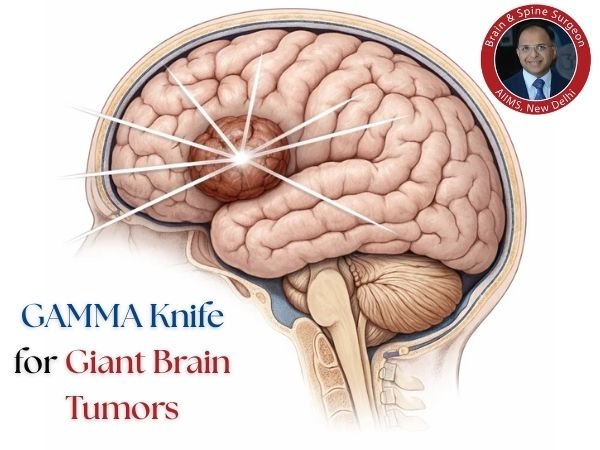
Gamma Knife for giant brain tumors

However, treatment choices have changed due to advances in neurosurgery, particularly Gamma Knife for giant brain tumors. Many patients nowadays enquire:

Is it possible to treat massive brain tumours without surgery?

The response is: Yes, under certain situations.

This guide describes what patients can anticipate, when Gamma Knife is appropriate, and how it functions for large brain tumours.

A Giant Brain Tumour: What Is It?
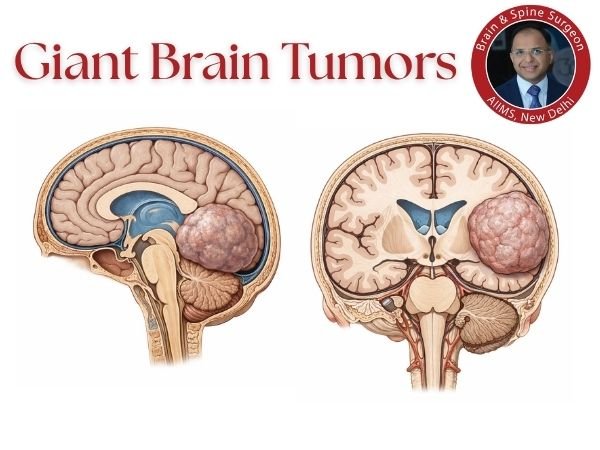
Giant Brain Tumors
Giant Brain Tumors

A brain tumour that is greater than 3–4 cm in diameter is usually referred to as a giant brain tumour.

These tumours could:

  • Compress adjacent brain regions
  • Raise the intracranial pressure

Cause symptoms like:

  • Excessive headaches
  • Seizures and vomiting
  • Speech or vision issues

Typical instances consist of:

  • Meningiomas
  • Schwannomas of the vestibular
  • Adenomas of the pituitary
  • Brain tumours that spread

Is It Possible to Treat Giant Brain Tumours Without Surgery?

The Brief Response:

  • Yes, although not necessarily in a single session.

Large tumours are difficult because:

High radiation doses administered in a single session have the potential to harm nearby brain tissue.
Mass effect, or pressure, is frequently caused by giant tumours and may require immediate alleviation.

Related Post: Life After Brain Tumour Surgery: Recovery, Care and Lifestyle Changes

Contemporary Method for Big Tumours
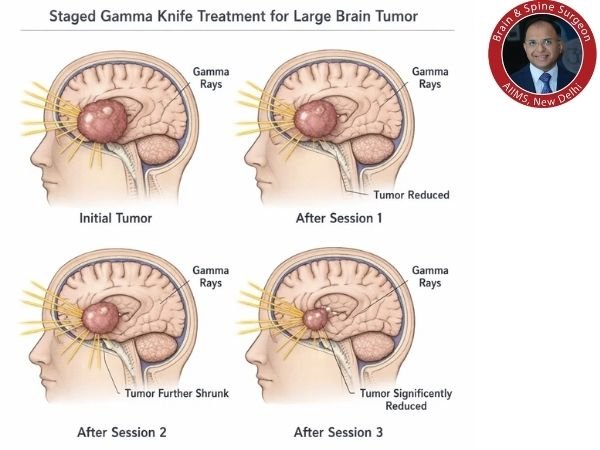
staged gamma knife treatment for large brain tumor

1. Gamma Knife Radiosurgery in Stages

  • There are several sessions (stages) of treatment for the tumour.
  • A safe radiation dose is administered during each session.
  • Permits the tumour to gradually shrink

2. Combined Method (Hybrid Therapy)

  • Gamma Knife + partial surgical removal (debulking)
  • Tumour size is decreased by surgery
  • The remaining tumour is targeted by Gamma Knife.

3. Radiosurgery using Fractionation

  • Radiation is administered over a number of days.
  • Safer for tumours that are close to important brain regions

When Can Giant Tumours Be Treated with a Gamma Knife?
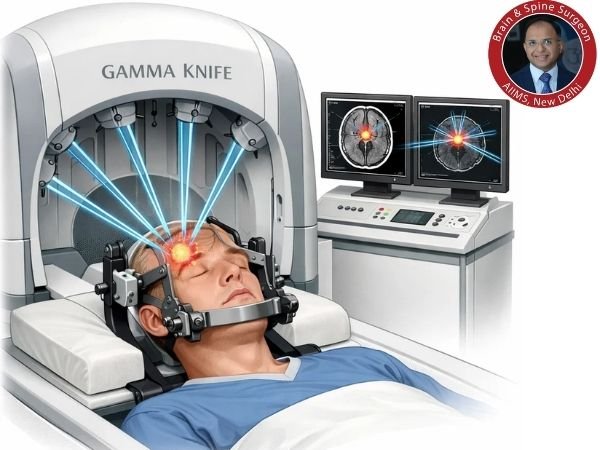
multiple radiation beams converging on tumor

Gamma Knife for giant brain tumors might be suggested if:

  • The tumour is located in a deep or challenging area.
  • The patient is unfit for open surgery.
  • The tumour is benign or grows slowly.
  • After surgery, a residual tumour persists.
  • The tumour is near important structures, such as the brainstem and optic nerves.

Gamma Knife’s Benefits for Big Brain Tumours

1. Non-Invasive Therapy

  • No surgical risks, stitches, or cuts.

2. Excellent Accuracy

  • Keeps healthy brain tissue intact by focusing just on the tumour.

3. Less Dangerous Than Surgery

Decreased chance of:

  • Infection
  • Bleeding
  • Neurological issues

4. Quicker Recuperation

  • In one to two days, the majority of patients resume their regular lives.

5. Perfect for Patients at High Risk

  • Appropriate for people who are aged or medically unfit.

Gamma Knife’s Drawbacks for Giant Tumours

It’s critical to realise that Gamma Knife for giant brain tumors is not a universally applicable option.

  • Unsuitable for brain edema or tumours that cause extreme pressure
  • It could take months for large tumours to shrink.
  • There is little immediate symptom alleviation.
  • It could be necessary to have several sessions.

What Takes Place Throughout the Process?

Procedure in Steps:

  1. Mask Placement or Frame Fixation
    Precision is guaranteed with a head frame or mask.
  2. Imaging
    To find the tumour, MRI and CT scans are performed.
  3. Planning for Treatment
    Radiation specialists and neurosurgeons coordinate the dosage.
  4. Delivery of Radiation
    The tumour is targeted by focused rays.
  5. Observation Following Treatment
    Typically, patients are released the same day.

Recuperation Following Gamma Knife

  • No wounds from surgery
  • There could be a slight headache or weariness.
  • Most patients rapidly return to their regular activities.
  • Over several weeks to months, the tumour gradually shrinks.

Gamma Knife’s Success Rate for Big Tumours

  • Outstanding benign tumour control rates (80–95%)
  • Controlling the growth of metastatic tumours effectively

Long-term results rely on:

  • Type of tumour
  • Size
  • Location
  • Health of the patient

Dangers and Adverse Reactions

Despite being safe, potential adverse effects include:

  • Brain swelling that is transient
  • A headache
  • Feeling queasy
  • Uncommon neurological deficiencies

These are often controllable and transient.

Concluding Notes

Brain tumour treatment has been transformed by Gamma Knife for giant brain tumors, which provides a non-invasive, safe substitute for conventional surgery.

It may not always take the place of surgery for big brain tumours, but it frequently plays a crucial part in treatment, either on its own or in conjunction with other methods.

The optimal course of treatment is always customised, taking into account the patient’s health as well as the size and location of the tumour.

FAQ’s

1. Can a big brain tumour be totally removed using Gamma Knife?

The tumour is not immediately “removed” by Gamma Knife. Over time, it slows growth and progressively reduces it.

2. For big tumours, is Gamma Knife preferable to surgery?

It varies.

  • For quick decompression, surgery is preferable.
  • Gamma Knife is perfect for residual tumours and precise therapy.

3. How much time does it take for a tumour to get smaller?

Depending on the type of tumour, tumour shrinking could take three months to many years.

4. Does the process hurt?

No, it is painless, albeit the head frame may cause some slight discomfort.

5. Is it possible to replicate Gamma Knife?

Yes, repeat sessions can be carried out safely in some situations.

6. Is hospitalisation necessary?

Usually, it’s not necessary. The majority of patients return home the same day.

7. Who isn’t eligible for Gamma Knife?

Individuals with:

  • Extremely big tumours that severely squeeze the brain
  • Instead, a rapidly worsening neurological disease
  • May necessitate immediate surgery.

Sources:

https://pubmed.ncbi.nlm.nih.gov/18503337/
https://pubmed.ncbi.nlm.nih.gov/9782231/
https://pubmed.ncbi.nlm.nih.gov/11143259/
https://pubmed.ncbi.nlm.nih.gov/24917309/
https://pmc.ncbi.nlm.nih.gov/articles/PMC7034742/
https://pmc.ncbi.nlm.nih.gov/articles/PMC12317634/

You May Also Know Related to Gamma Knife
FAQ’s

Gamma Knife uses 192–201 precisely focused beams of gamma rays that converge at a single target point in the brain. This high dose of radiation damages the DNA of abnormal cells, stopping their growth or causing them to shrink, while minimizing exposure to nearby healthy tissue.

No, Gamma Knife is not a traditional surgery. It is a non-invasive outpatient procedure performed without any incision, stitches, or general anesthesia in most cases.

Gamma Knife is commonly used for:

Brain tumors (benign and malignant)
Metastatic brain lesions
Arteriovenous malformations (AVMs)
Trigeminal neuralgia
Acoustic neuromas (vestibular schwannomas)
Pituitary tumors
Certain functional disorders (like tremors)

The procedure is generally painless. Patients may feel mild pressure while the head frame (if used) is applied or may experience slight discomfort from anesthesia injections, but the treatment itself is not painful.

Depending on the condition and treatment plan, Gamma Knife may take 30 minutes to 3 hours. Most patients go home the same day.

Common side effects are usually mild and temporary, including:

Headache
Nausea
Fatigue
Mild scalp swelling or tenderness at the frame site
Rarely, some patients may experience delayed radiation effects such as brain swelling or radiation necrosis.

Most patients can return to their normal routine within 24–48 hours after the procedure.
You may feel mild fatigue for a few days.
Follow-up imaging is usually required after 1 year.

Gamma Knife has a high success rate and has been used worldwide for decades. Its effectiveness depends on the condition treated, size and location of the lesion, and overall patient health. In many cases, it offers results comparable to open surgery with fewer risks.

Yes, in some cases Gamma Knife treatment can be repeated if the disease recurs or if new lesions develop.

Yes. Gamma Knife is considered one of the safest and most precise forms of radiosurgery, with millions of patients treated globally and extensive clinical data supporting its use.

Eligibility depends on factors such as:

Size and location of the lesion
Overall health and age
Whether open surgery is too risky
A neurosurgeon and radiation oncologist will decide if Gamma Knife is the best option for you.

A detailed MRI or CT scan is performed to map the brain.
A lightweight head frame or mask is used for accuracy.
Your doctors plan the radiation dose and target areas using specialized software.

Local anesthesia is given if a head frame is used.
General anesthesia is usually not required, except for children or patients unable to remain still.

Costs vary depending on hospital, city, and condition treated. On average, Gamma Knife in India ranges from ₹1.5 lakh to ₹4.5 lakh. It is usually more affordable compared to treatment in Western countries. At AIIMS Delhi, it is much more affordable around ₹75,000 which makes it affordable for the patients in need.

AIIMS Delhi is one of the leading centres for Gamma Knife in India.

AIIMS uses the latest Gamma Knife Perfexion system.

It has successfully treated thousands of patients for brain tumors, blood vessel problems, and even eye cancers.

The treatment is done by expert neurosurgeons such as Dr. Deepak Agrawal and team.

Clinic timings for Gamma Knife OPD at AIIMS Delhi: Monday & Friday, 8:00 AM – 9:00 AM.

Cost is around ₹75,000 and is subsidized compared to private hospitals.

The whole procedure is usually done in one day:

  • Consultation & Planning – Doctors review your scans and decide the treatment.
  • Head Frame/Mask – A lightweight frame or mask is placed to keep your head still.
  • Imaging – MRI/CT scans are done to locate the exact target.
  • Treatment Planning – Specialists plan the dose and direction of radiation.
  • Gamma Knife Treatment – You lie on the machine; painless radiation beams treat the target (30 mins–3 hrs).
  • Recovery & Discharge – The frame is removed, and most patients go home the same day.
  • Follow-up – MRI after a few months to check results.

Before you get a treatment date, you need to complete a few steps:

  • OPD Registration – Visit the Neurosurgery OPD (Gamma Knife clinic at AIIMS, Mon & Fri 8–9 AM) and register.
  • Consultation with Doctor – Meet the neurosurgeon who will check your reports, MRI/CT scans, and medical history.
  • Investigations – Sometimes fresh MRI/CT or blood tests are needed for treatment planning.
  • Medical Fitness – Basic checks like blood pressure, sugar, heart condition, etc.

Financial/Insurance Approval –

  1. If using Ayushman Bharat or government schemes, you need approval papers.
  2. If self-paying, you will be given the estimated cost (~₹75,000 at AIIMS).
  • Consent & Admission Slip – Once doctors confirm you are fit and formalities are done, you sign the consent form.
  • Treatment Date Allotment – A date is given for your Gamma Knife procedure.

Once you receive your Gamma Knife date, you’ll need to do a few simple things before the procedure:

  • Admission Process – Report to AIIMS on the morning of your procedure and complete admission at the Neurosurgery ward/Daycare.
  • Paperwork – Carry your OPD slip, MRI/CT films, blood test reports, admission slip, and ID proof. If you are covered under Ayushman Bharat/insurance, keep those approval papers ready.
  • Consent Forms – You (or a family member) will sign consent for the procedure and anesthesia.
  • Medical Check-up – Doctors will check your BP, sugar, heart rate, and do a quick physical exam.
  • Fasting – Usually, you will be asked to not eat or drink for 6 hours before the procedure.
  • Pre-Procedure Prep – An IV line may be put, and medicines (sedation/antibiotics if needed) are given.
  • Treatment – You are then taken to the Gamma Knife room for frame/mask placement, imaging, and treatment.

After the procedure, you’ll be observed for a few hours and most patients are discharged the same day or next morning.

No, You can have light breakfast.

Yes, you can take the medicine and then come for the treatment.

Table of Contents