Using sophisticated endoscopic procedures, pituitary surgery is a highly specialised treatment carried out through the nose. Even though pituitary surgery is usually safe and successful, one of the most crucial side effects that patients should be aware of is CSF leak.
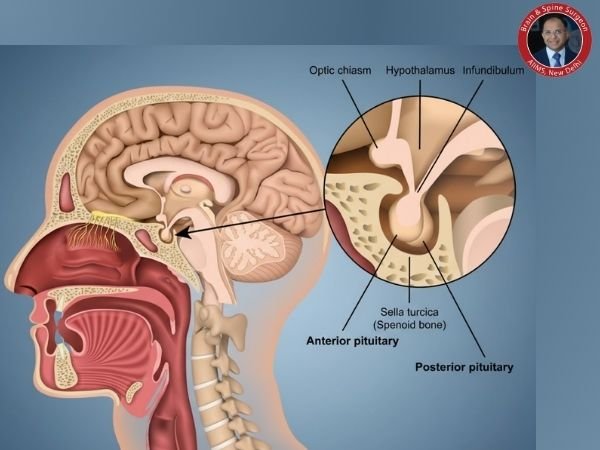
This guide describes the most cutting-edge repair techniques utilised in contemporary skull base surgery, as well as what a cerebrospinal fluid (CSF) leak is and why it occurs.
Overview of CSF Leak in Surgery of the Skull Base
Endoscopic transsphenoidal surgery, a minimally invasive procedure that allows surgeons to approach the tumour through the nasal passages, is frequently used to remove pituitary tumours.
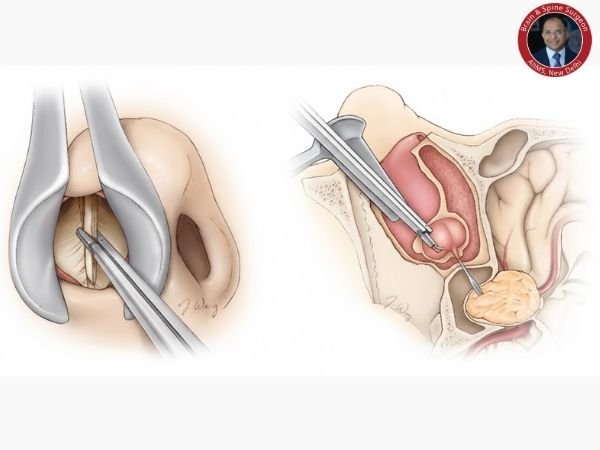
Large incisions are avoided, healing time is shortened, and accuracy is increased with this method. Surgeons must, however, exercise caution while working close to the dura, the brain’s protective covering, because the pituitary gland is located just beneath the brain.
After pituitary surgery, there may be a CSF leak if this covering is damaged.
Knowledge of CSF (cerebrospinal fluid) leaks
The clear, colourless substance known as cerebrospinal fluid (CSF) envelops and shields the brain and spinal cord. It serves as a cushion and keeps the skull’s pressure level.
After pituitary surgery, a CSF leak happens when this protective fluid seeps into the nasal cavity through a defect in the base of the skull.
Signs of a CSF leak include:
The nose’s clear, watery discharge
A metallic or salty aftertaste
A headache that becomes worse when you stand
Infection risk, including meningitis
Prompt treatment and early detection are essential.
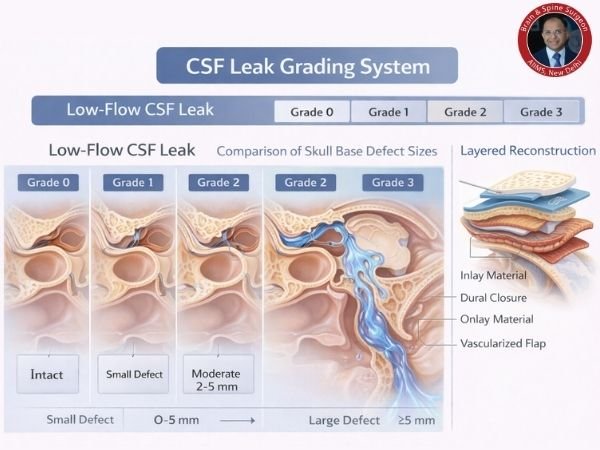
3. Leak Grading System for CSF
Leaks are not all the same. Surgeons categorise them according to their severity.
Grade 0: No Leak
During surgery, there is no apparent CSF escape.
Least dangerous.
Conventional closure methods are adequate.
Grade 1: Leak with Low Flow
Significant leak.
CSF escape is minimal.
Usually doable with basic repair methods.
Grade 2: Moderate Seepage
Noticeable leak.
Layered reconstruction is necessary.
Riskier than Grade 1.
Grade 3: Leak with High Flow
Substantial gap between the nasal and brain cavities.
Large outflow of CSF.
Calls for sophisticated reconstruction methods.
High-Flow Leaks’ Frequency in Skull Base Surgery
Large or complicated pituitary tumours can have high-flow leaks, particularly when:
The tumour invades the surrounding brain coverings.
Revision procedures are carried out.
Longer approaches to the skull base are required.
Advances in surgical technique have considerably decreased the frequency of chronic postoperative CSF leak following pituitary surgery.
The Significance of CSF Leakage as a Serious Issue
Untreated CSF leak can result in:
Meningitis, or infection of the brain
Postponed recovery
Re-operation is required.
Extended hospitalisation
The main objective of reconstruction is to seal the base of the skull securely and prevent infection.
Conventional Methods for Skull Base Reconstruction
Previous methods included:
Grafts of fat (from the thigh or abdomen)
Grafts of the fascia lata
Synthetic materials
The tissue glue
High-flow leaks needed more dependable treatments, even though they were often effective.
Hadad Flap: An Innovation in Skull Base Restoration
The Hadad-Bassagasteguy flap, also referred to as the Hadad flap, is one of the most important developments in skull base surgery.
This method reconstructs the skull base defect using vascularised nasal septum tissue, which has its own blood supply.
Reason why It’s Revolutionary:
Offers robust, live tissue protection.
Quicker recovery
Significantly lowers the rates of postoperative CSF leakage
Especially efficient for leakage of Grades 2 and 3.
The results of contemporary pituitary surgery and skull base surgery have been revolutionised by the Hadad flap.
Multi-Layer Skull Base Reconstruction Principles
A multi-layer technique is used in modern rebuilding, which means that multiple protective layers are employed:
Graft material in the inner layer, which seals the dura
Structural reinforcement in the middle layer
Vascularised flap in the outer layer (similar to a Hadad flap)
Sealants: biological adhesives or fibrin glue
The chance of a subsequent CSF leak following pituitary surgery is greatly reduced by this multi-layered approach.
New Developments in CSF Leak Repair
Recent developments consist of:
High-definition endoscopic visualisation
Navigation systems that use images
Vascularised flaps
Bio-based sealants
Planning for a customised reconstruction
Better patient outcomes and accurate closure are made possible by these technologies.
Skull Base Reconstruction Using the Mini Plate Technique
Surgeons may employ microplates to give the skull base restoration process structural stability.
Advantages:
Provides mechanical assistance
Stops the displacement of grafts
Beneficial for significant bony deficiencies
Lowers the chance of recurrence
This method works particularly well in circumstances of complicated high-flow CSF leak.
Techniques to Prevent CSF Leaks
Prevention begins prior to surgery:
Comprehensive MRI analysis
Thorough surgical preparation
Evaluation of tumour size
Skilled surgical team at the skull base
Handling tissues gently
Preventive rebuilding in situations with a high risk
Patients should take the following postoperative precautions:
Avoid nose blowing
Avoid heavy lifting
Avoiding a strong forward bend
Reporting a clean nasal discharge right away
Additional Serious Issues: Damage to the Carotid Arteries
Although it is uncommon, one of the biggest concerns with pituitary surgery is carotid artery damage.
The surgical field is in proximity to the internal carotid arteries. This risk is greatly reduced by precise surgical techniques and contemporary positioning technologies.
In such uncommon circumstances, prompt identification and sophisticated vascular management methods are crucial.
Related Post: Endoscopic Endonasal Transsphenoidal Approach for Pituitary Adenoma
Important Surgical Techniques
One well-known but controllable side effect of pituitary surgery is CSF leakage.
The reconstruction strategy is determined by proper grading.
Results are improved by multi-layer reconstruction.
Skull base restoration was transformed by the Hadad flap.
Infection is avoided with early detection.
Selecting a skilled skull base neurosurgeon greatly lowers risks.
Most patients recover safely and without long-term consequences with the help of advanced equipment and skilled care.
In conclusion
One serious but avoidable and manageable side effect of skull base surgery is a CSF leak following pituitary surgery. Results have significantly improved thanks to multi-layer reconstructive methodologies, vascularised flaps like the Hadad flap, and contemporary endoscopic techniques.
Selecting a skilled neurosurgeon with advanced training in skull base reconstruction is crucial for the safe and efficient treatment of pituitary surgery, whether you or a loved one is having it done.
FAQ’s
1. How frequently does CSF leak following pituitary surgery occur?
The risk is minimal with contemporary methods, particularly when used by skilled practitioners. Although less frequent, high-flow leaks need sophisticated correction.
2. What is the sensation of a CSF leak?
Patients frequently experience salty-tasting, clear, watery nasal discharge.
3. Is a CSF leak self-healing?
While small leaks can occasionally close on their own, the majority of postoperative leaks need to be managed medically or surgically.
4. How do you diagnose a CSF leak?
Imaging investigations, fluid testing, and clinical examinations may all be used in the diagnosis process.
5. Can a CSF leak be fatal?
It can cause meningitis, which is a dangerous condition if left untreated. Complications are avoided with early treatment.
6. After reconstruction, how long does healing take?
Depending on the complexity of the reconstruction and the extent of the leak, most patients recover in a few weeks.