Long-term impairment, significant weakness, and loss of movement can result from injuries to the nerves that govern the arm and shoulder. The Oberlin method, a contemporary nerve transfer technique frequently used to treat brachial plexus injuries, is one of the most sophisticated surgical options for such injuries.
For patients who suffer nerve injury and are unable to bend their elbow or move their shoulder, the surgery has greatly improved outcomes. Everything a patient or carer needs to know about the Oberlin procedure nerve surgery is included in this guide, including how it operates, when it is necessary, and what the recovery time takes.
The Oberlin Procedure: What is it?
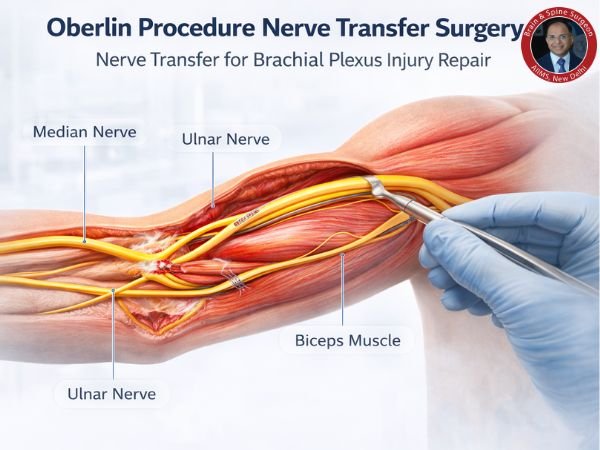
Patients with brachial plexus injuries can regain elbow and shoulder function using the Oberlin operation, a kind of nerve transfer surgery.
The method entails moving a little section (fascicle) of a healthy nerve—typically the median or ulnar nerve—to a damaged nerve that supplies the biceps muscle. This aids in the recovery of arm function and elbow flexion.
Why it Functions
By transmitting electrical information, nerves regulate muscles. A damaged nerve can cause a muscle to weaken or become paralysed.
During the Oberlin process:
A nerve fascicle that is in good health is found
It is diverted to the injured nerve that supplies the biceps
Function is eventually restored when the grafted nerve develops into the muscle
Recovery is typically quicker than with standard nerve grafting since the repair is made in close proximity to the target muscle.
Brachial Plexus Injury Treatment
The network of nerves (C5–T1) that controls the hand, arm, and shoulder is called the brachial plexus.
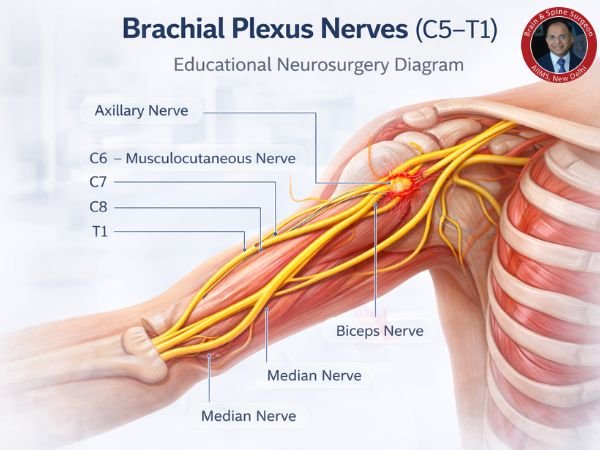
This network may be harmed by:
Traffic accidents on roads
Motorbike collisions
Falls from a height
Sports-related injuries
Trauma associated with childbirth (obstetric brachial plexus palsy)
These wounds could result in symptoms like:
Loss of arm range of motion
Shoulder or elbow weakness
Arm numbness
Lifting or bending the elbow is difficult
Options for Treatment
The kind and extent of nerve damage determine the course of treatment.
Non-surgical Therapies
Physical therapy
Pain control
Braces or splints
Therapy for rehabilitation
Surgical Procedures
Grafting nerves
Repairing nerves
Surgery for nerve transfer (like the Oberlin technique)
Among these, nerve transfer procedures have grown in popularity due to their superior functional results and quicker reinnervation.
Double Oberlin Method for Neurotization of the Suprascapular Nerve
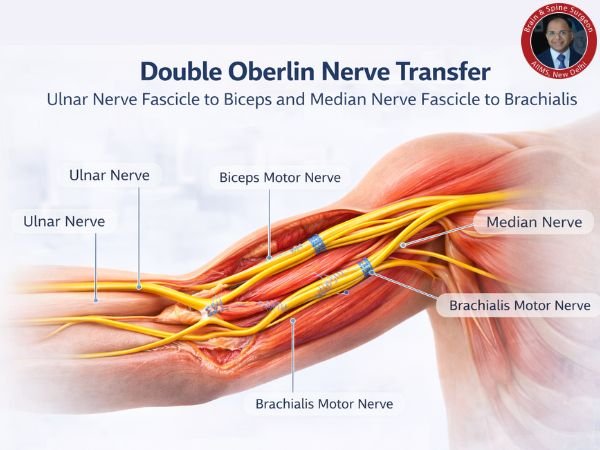
An improved version of the original treatment is called the Double Oberlin procedure.
To improve elbow flexion, doctors transfer two nerve fascicles rather than just one.
How the Double Transfer Operates
Biceps muscle nerve → Ulnar nerve fascicle
Brachialis muscle nerve → Median nerve fascicle
The strength and stability of elbow bending are enhanced by this dual transfer.
To restore shoulder movement and stability, surgeons frequently combine this operation with suprascapular nerve neurotization, which frequently uses the spinal accessory nerve.
This combination approach aids in the restoration of:
Flexion of the elbow
Abduction of the shoulder
Control of the arms
Is It Possible to Repair Shoulder Nerve Damage?
Yes, shoulder nerve injury is frequently curable, particularly with prompt treatment.
Over time, peripheral nerves can regenerate gradually, usually at a rate of one millimetre per day.
However, a number of variables affect how well a treatment works.
Recovery-Related Factors
Nerve injury kind and severity
The interval between an injury and surgery
The patient’s age
Normal condition of the muscles
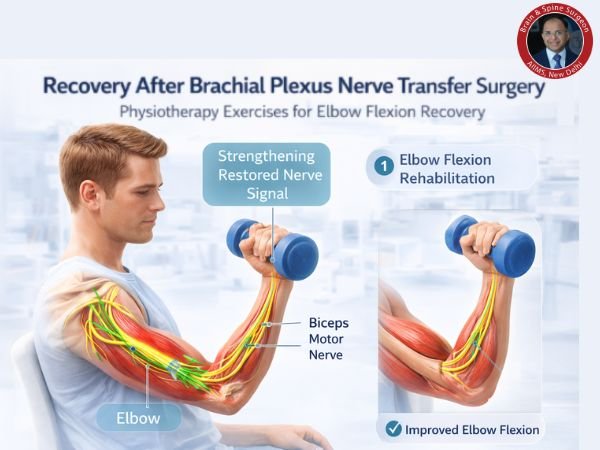
Research indicates that when nerve transfer treatments, such as the Oberlin approach, are carried out during the first six to twelve months following damage, a significant proportion of patients can regain functional elbow flexion.
The Operation of Nerve Transfer Surgery
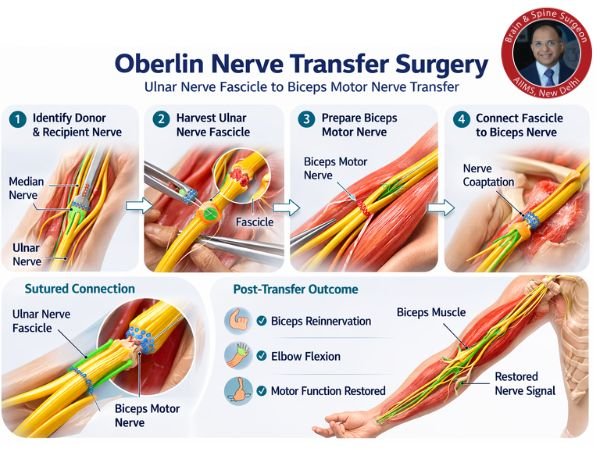
Neurotization is the foundation of nerve transfer surgery.
A Detailed Synopsis
Finding a healthy donor nerve
Typically, a little fascicle from the median or ulnar nerveIsolation of the injured nerve
Usually, the nerve branch that supplies the shoulder or biceps musclesMicrosurgical attachment
Microsurgical sutures are used to join the damaged nerve to the donor nerve fascicleRegeneration of nerves
The target muscle starts to develop from the transferred nerveReactivation of muscles
Over several months, muscle function gradually returns
This method reduces the time required for nerve regeneration by directly transferring a working nerve to a nearby muscle.
Recuperation Following Brachial Plexus Surgery
The Oberlin treatment needs patience and therapy, and recovery is gradual.
Recovery Timeline
Initial weeks
Immobilisation of the arms
Pain control
Mild physical treatment
3–4 months
Muscle activation may show early symptoms
6–12 months
Elbow flexion gradually improves
12 to 24 months
Sustained strengthening and functional recuperation
Within three to four months following surgery, some individuals start to restore elbow movement.
Rehabilitation is Essential
Included in postoperative therapy are:
Physical therapy
Stimulation with electricity
Strength training
Occupational therapy
These aid in retraining the brain to perform new tasks using the transplanted neuron.
The Oberlin Procedure’s Advantages
Compared to conventional nerve repair methods, the Oberlin procedure nerve surgery offers a number of advantages.
Principal Advantages
Quicker regeneration of nerves
Restoring elbow flexion has a high success rate
Donor nerve functional loss is minimal
Reduced recuperation time
Effective even in cases of severe brachial plexus injuries
The donor nerve function is not significantly weakened in the majority of patients since the procedure only employs tiny fascicles from healthy nerves.
Who Qualifies for the Oberlin Procedure?
This procedure may be advantageous for patients who have:
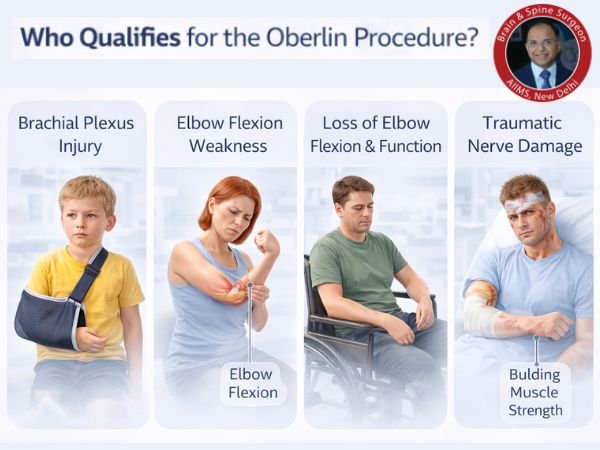
Damage to the upper brachial plexus (C5–C6)
Elbow flexion loss
Intact function of the median or ulnar nerves
Injury that is younger than 12 months
The optimal course of treatment is determined by a thorough evaluation that includes:
Nerve conduction testing
MRI
Clinical examination
When to See a Neurosurgeon
If you encounter:
Abrupt loss of arm strength
Paralysis of the elbow or shoulder following trauma
Arm weakness that never goes away
Incapacity to raise the arm or numbness
A neurosurgeon skilled in brachial plexus surgery should be consulted.
Recovery and function restoration can be greatly enhanced by early diagnosis and therapy.
Conclusion
An important development in the management of brachial plexus injuries is the Oberlin procedure.
This microsurgical procedure can greatly enhance arm function and restore elbow movement by transplanting healthy nerve fibres to damaged nerves.
Patients may improve their independence and quality of life by regaining both elbow and shoulder function when paired with operations such as the Double Oberlin Procedure for Suprascapular Nerve Neurotization.
FAQ’s
1. How successful is the Oberlin procedure?
Many patients experience enhanced arm movement and functional elbow flexion following the operation, which has a high success rate.
2. Is the Oberlin process secure?
Indeed. It is regarded as a popular and safe microsurgical method for treating lesions to the brachial plexus.
3. Does the donor nerve get weaker after the procedure?
Usually no. Only a small portion of the nerve is used, and most patients retain normal function in the donor nerve.
4. What is the duration of nerve regeneration?
Complete functional recovery may take up to 12 months because of the sluggish rate of nerve regeneration.
5. Will shoulder mobility be restored after the surgery?
Indeed. When combined with procedures like suprascapular nerve neurotization, shoulder movement can also improve.
6. Is physical therapy required following surgery?
Of course. For the best possible healing and muscular building, rehabilitation is crucial.
Sources:
- https://pubmed.ncbi.nlm.nih.gov/31798318/
- https://pmc.ncbi.nlm.nih.gov/articles/PMC8984725/#table2-1558944720918325
- https://pubmed.ncbi.nlm.nih.gov/23037815/
- https://pubmed.ncbi.nlm.nih.gov/17147774/
- https://www.researchgate.net/publication/232087335_Efficacy_and_Safety_of_Oberlin’s_Procedure_in_the_Treatment_of_Brachial_Plexus_Birth_Palsy
- https://pmc.ncbi.nlm.nih.gov/articles/PMC1636634/