
The brain communicates with the rest of the body, including the muscles, organs, and peripheral nerves, through the spinal cord, a network of nerves. The health issue of the spinal cord affects every bodily function. These signals may be interfered with after a spinal cord injury, leading to a loss of feeling and motor function.
The spinal column and spinal cord may have been seriously damaged if someone might have experienced a traumatic event. Depending on the kind and location of the injury, the outcome of a spinal cord injury can vary. The most frequent ones are motor, sensory, and autonomic nerve function slowdowns in some internal organs below the injury site. In general, function, sensation, and internal bodily functions will be more negatively impacted by injuries that occur higher in the spinal cord.
Spinal cord surgery could be required to maintain as much function as feasible and stop secondary damage from getting worse.
What is Spinal Cord Injury?
Damage to the spinal cord, a dense network of nerve fibres that connects your brain to nearly every other nerve in your body, results in a spinal cord injury (SCI). These wounds might be small and treatable or serious and irreversible.

One of the two parts of your central nervous system (CNS) is the spinal cord. The nervous system works similarly to a multilane bridge going to and from the brain, which is the other part of the central nervous system. It includes lanes for traffic going into and going out of your brain, respectively.
Your spinal nerves, which are like on-and-off-ramps connecting to peripheral nerves that branch out everywhere else in your body, are connected to your spinal cord. The vehicles that use those on-ramps and travel this motorway are nerve signals.
The paths in this motorway are affected by spinal cord injuries, which are similar to closures. The spinal cord, however, lacks detours, in contrast to an actual motorway. Traffic using the closed lanes is unable to get to its objective. The closure may be permanent if the damage is significant enough. Paralysis and other severe symptoms of SCI injuries are caused by it.
A severe neurological disorder, spinal cord injury (SCI), has a significant socioeconomic impact on both those affected and the healthcare system. According to the Indian Spinal Injuries Centre (ISIC), approximately 20,000 new cases of spinal cord injury (SCI) are reported annually in India. Road traffic accidents are the leading cause, accounting for 44% of these injuries, followed by falls from height at 38.3%. Over 90% of SCI incidents are traumatic and result from events like falls, violent crimes, sports, or auto accidents.
Spinal Cord Injury, which affects adults more often than children, has a male-to-female ratio of 2:1. In terms of demographics, women are more vulnerable during adolescence (15–19 years), whereas men are primarily impacted during early and late adulthood. This means that the age distribution is bimodal, with a first peak involving young adults and a second peak involving adults over 60. The chances of recovery for SCI patients over 60 are significantly poorer than those for younger individuals; falls and age-related bone changes are typically the cause of these injuries
However, there are currently no recognised methods to correct spinal cord damage. Yet scientists are always developing new treatments, such as prosthetics and drugs, that could encourage nerve cell regeneration or enhance the functionality of the nerves that survive a spinal cord injury.
The current goals of SCI treatment are to stop additional harm and enable those who have a SCI to resume an active and productive life.
Types
Experts categorise the different kinds of spinal cord injury in two ways: the extent to which the accident affects your spinal cord and the location of the injury. Anywhere below where it occurs, nerve signal flow can be affected by a SCI.
By location:

Your neck contains the cervical spine. It extends from the base of your skull to roughly shoulder level.
The thoracic spine extends from the upper back to the area closest to the navel, or belly button.
Your lower back contains the lumbar spine. Your spinal cord ends a few inches above the point where your buttocks meet, but it extends roughly to that point.
Your back contains the sacral spine. Nerve roots run through your butt to your tailbone.
In terms of severity:
Incomplete: An incomplete SCI is comparable to a shutdown that solely impacts a few lanes. Some abilities below the injury are still intact because others are still open.
Complete: Every lane is impacted by a complete SCI. There is no traffic. It typically results in paralysis and the irreversible loss of all functions below the damage.
The 31 segments of your spinal cord correspond to the 31 pairs of spinal nerves. Experts identify them using combinations of letters and numbers. The segment of the spine is indicated by the number, and the section is indicated by the letter. For instance, C8 denotes the eighth (and lowest) section of the cervical spinal cord.
Multiple phases are also frequently included in SCIs. The original injury is the first stage. However, a secondary injury may also occur in the hours and days that follow, resulting in swelling and more spinal cord damage.
Related Post: An Innovative Approach for Treating Complete Cervical Spinal Cord Injury: Expansive Duraplasty
What Physical Impacts Can a Spinal Cord Injury Have?
If there is damage that prevents nerves from communicating with the brain, the body loses numerous vital processes. Damage to the spinal cord may impact:

Bowel (intestinal) and bladder function
Heart rate and breathing
The process by which the body turns food into energy, or Metabolism.
Movement of muscles
Reflexes and Feelings
What are the spinal cord injury treatment options?
At the Incident’s Scene:

In order to minimise the effects of head, neck, or back trauma, early medical attention is essential. As a result, SCI treatment frequently starts at the site of the injury.
Responding to emergencies usually:
Use a strong carrying board and a rigid neck collar to immobilise the spine as fast and carefully as possible.
Take the patient to the hospital using the carrying board.
In the emergency department:
Surgery. To remove fluid or tissue pressing on the spinal cord, doctors may perform surgery (decompression laminectomy); remove foreign objects, disc fragments, or pieces of bone; fuse fractured spinal bones; or insert spinal braces.
Traction. The spine is stabilised and aligned properly with this method.
Medrol, or methylprednisolone. Some people show improvement if this steroid drug is given within 8 hours of the accident. It seems to function by lessening inflammation close to the injury site and minimising damage to nerve cells.
Experimental therapies. Researchers are working to prevent cell death, manage inflammation, and encourage neurone regeneration or repair.
What effects does SCI have on kids?
Although there are not many SCI cases among children and adolescents compared to other age groups, a SCI may have a greater negative impact on their medical results. SCI in children and adolescents has been the subject of relatively few investigations to date, and many issues remain. Among these questions is how children and teenagers’ growth and development are impacted by having a spinal cord injury.

Additionally, a kid with a SCI may experience more secondary illnesses (such as respiratory and bowel/bladder issues) because their trunk support system is less established than that of an adult. Additionally, due to skeletal immaturity, children and adolescents may be more prone to a secondary skeletal disease.
How do people cope with having SCI?
A person’s life can be drastically altered by paralysis. At first, thinking about how to resume past connections and activities—like those with family, friends, work, and leisure/exercise—can be depressing, terrifying, and intimidating.
Nevertheless, a SCI patient can have a happy and fulfilling life and build a strong support network and motivation for their recovery.
American Spinal Injury Association
Christopher and Dana Reeve Foundation
National Spinal Cord Injury Association
Paralyzed Veterans of America
Shriner’s Hospitals for Children
Spinal Injury 101
What effects does SCI have on the body as a whole?
Many bodily functions may undergo significant changes following a SCI. The following problems could occur: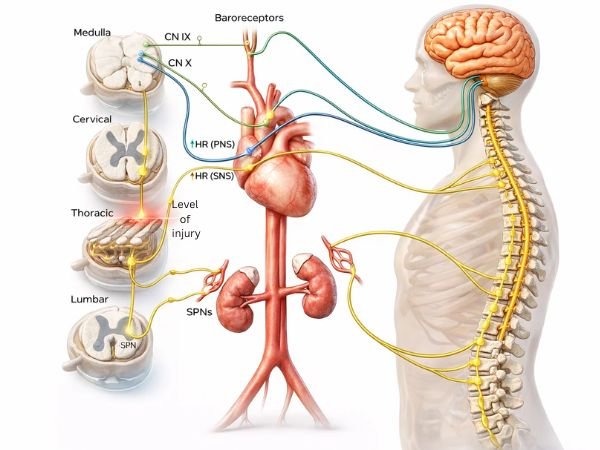
Loss of bone due to obesity
Atrophy of muscles
Sores caused by pressure
Bowel and bladder issues
Heart-related issues
Modifications to sexual and reproductive processes
Pain, depression, and coping with illness
What signs/symptoms of a spinal cord injury are present?

Sensory Symptoms
Pain
Numbness
Paraesthesia
Motor symptoms
Weakness
Paralysis
Spasticity
Autonomic symptoms
Heart rate disturbances
Blood pressure disturbances
Body temperature disruptions
Urinary or fecal incontinence
Erectile dysfunction
Testing and Diagnosis
Physical exam
Neurological examination
MRI and CT scans
Nerve conduction testing and electromyography
Care and Therapy

SCI treatment depends on whether the injury is traumatic or non-traumatic and may involve surgery, medications, traction, braces, rehabilitation, and long-term care.
Prevention/Avoidance
Wear safety gear
Drive carefully
Avoid falls
Be cautious with firearms
Avoid alcohol and drugs
How do things stand with spinal cord injuries?
Recovery depends on injury severity. The first six months often see the fastest improvement, though recovery may continue for years.
Sources:
- https://pubmed.ncbi.nlm.nih.gov/28350947/
- https://pubmed.ncbi.nlm.nih.gov/33896529/
- https://www.physio-pedia.com/Spinal_Cord_Injury
- https://www.news9live.com/health/health-conditions/road-traffic-accidents-lead-to-44-spinal-cord-injuries-in-india-isic-study-2277706
- https://disability.trinayani.org/factsheet/spinal-cord-injury-sci/?utm_source=chatgpt.com
- https://health.economictimes.indiatimes.com/news/industry/road-traffic-accidents-are-leading-cause-of-spinal-cord-injuries-in-india-isic-study/103436561?utm_source=chatgpt.com
- https://thenorthlines.com/as-india-faces-an-alarming-rise-in-spinal-cord-injuries-the-call-for-a-comprehensive-support-system-has-never-been-more-urgent/?utm_source=chatgpt.com
- https://pubmed.ncbi.nlm.nih.gov/38330472/
- https://pmc.ncbi.nlm.nih.gov/articles/PMC4303788/
- https://pubmed.ncbi.nlm.nih.gov/28658409/
- https://www.nichd.nih.gov/health/topics/spinalinjury/conditioninfo/treatments
- https://www.mayoclinic.org/diseases-conditions/spinal-cord-injury/diagnosis-treatment/drc-20377895
- https://venturaortho.com/spinal-cord-injuries-when-surgery-is-the-solution/
- https://www.sciencedirect.com/science/article/pii/S2772529424000596
- https://my.clevelandclinic.org/health/diseases/12098-spinal-cord-injury
- https://www.nichd.nih.gov/health/topics/spinalinjury/conditioninfo/treatments#f2
- https://www.nichd.nih.gov/health/topics/spinalinjury/more_information/other-faqs#f5
- https://www.nichd.nih.gov/sites/default/files/publications/pubs/Documents/ncmrr_report_online_2006_historical.pdf
- https://www.nichd.nih.gov/sites/default/files/publications/pubs/Documents/ncmrr_report_online_2006_historical.pdf
- https://www.nichd.nih.gov/sites/default/files/publications/pubs/Documents/ncmrr_report_online_2006_historical.pdf
- https://www.nichd.nih.gov/about/org/ncmrr