One of the most fascinating developments in contemporary neuroscience and biomedical research is brain organoids, sometimes known as “mini-brains.” These microscopic, laboratory-grown structures replicate key features of the human brain, providing unprecedented opportunities to study brain development, neurological conditions, and potential therapies.
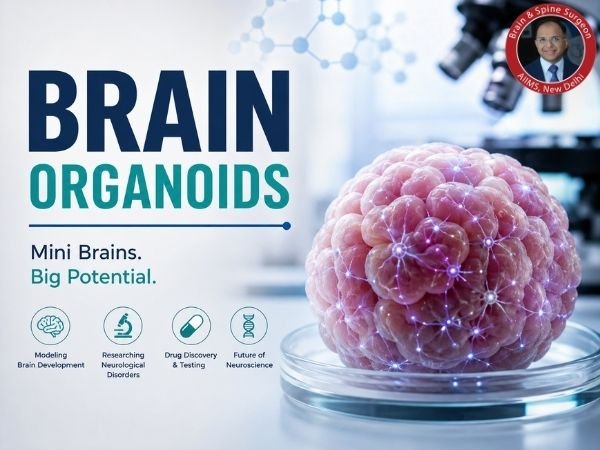
Patients and their families are becoming increasingly interested in brain organoid research, asking what these advancements mean for the future of neurology and neurosurgery. This guide provides a clear, medically grounded overview of brain organoids—explaining their development, benefits, clinical limitations, and future potential.
What Are Brain Organoids?
Brain organoids are three-dimensional (3D) cellular clusters grown in laboratory environments using stem cells. By directing stem cells to differentiate into specialized neural cell types, researchers can create micro-models of human brain tissue.
Unlike a fully developed human brain, organoids completely lack consciousness, sensory systems, and the capacity for thought. However, they are invaluable research tools because they reproduce critical structural and functional characteristics of early human brain tissue.
How Are Brain Organoids Made?
Creating brain organoids involves a precise four-step biological process:
- Stem Cell Collection: Pluripotent stem cells are collected, often reprogrammed from human skin or blood cell samples.
- Cell Differentiation: Specific growth factors and signaling molecules guide stem cells to develop into neural lineage cells.
- 3D Culturing: Cells are suspended in a nutrient-dense matrix environment to encourage growth into 3D spherical structures.
- Maturation: Over weeks or months, these organoids develop distinct cellular layers and features mirroring early human brain development.
Why Are Brain Organoids Important?
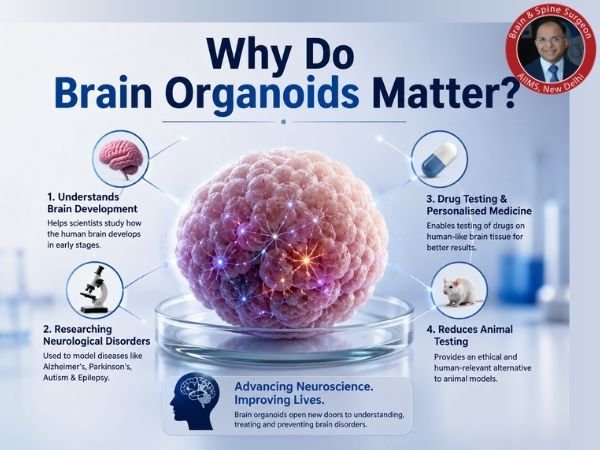
Brain organoids are expanding our understanding of neuroscience across several critical areas:
1. Understanding Brain Development
They enable scientists to observe early human neural development step-by-step in ways previously impossible with traditional models.
2. Modeling Neurological Conditions
Researchers utilize disease-specific organoid models to study complex neurological and neurodevelopmental conditions, including:
3. Personalized Medicine and Drug Screening
Organoids allow researchers to test therapeutic compounds directly on human-derived brain tissues, significantly improving drug safety profiles and treatment efficacy.
4. Ethical Alternatives to Animal Testing
They provide a more human-relevant, ethically sound alternative to traditional animal research models for targeted neuropharmacology.
Applications in Clinical Research and Neurosurgery
While primarily a research tool, brain organoids hold significant implications for future clinical and surgical practices:
- Enhanced understanding of brain tumors (e.g., patient-derived glioblastoma models)
- Studying repair mechanisms following traumatic brain injury
- Exploring tissue engineering and regenerative medicine strategies
- Refining pre-surgical planning through patient-specific disease modeling
These clinical advancements support neurosurgeons—including specialists like Dr. Deepak Agrawal, Professor of Neurosurgery at AIIMS Delhi—in staying at the forefront of emerging neuro-oncology and restorative neurosurgery options.
Limitations of Brain Organoids
Despite their capabilities, current brain organoids have several technical boundaries:
- Lack of Full Neural Complexity: They lack mature neural circuit organization and cross-region brain connectivity.
- Absence of Vascularization: Without a functional blood vessel system, organoid centers receive limited oxygen and nutrients.
- Size and Lifespan Restrictions: Growth is physically capped by the absence of nutrient delivery systems.
- Ethical Boundaries: Requires stringent oversight as organoid models become more sophisticated over time.
Because of these limitations, organoids serve as supportive laboratory tools that complement, but do not replace, comprehensive clinical research and actual patient data.
Ethical Considerations in Organoid Research
As biotechnology advances, bioethicists and neuroscientists actively monitor key questions:
- Could organoids ever develop sensory perception or primitive consciousness?
- What are the appropriate boundaries for human-derived neural research?
- How should donor consent be handled for neural stem cell lines?
- What regulatory frameworks are required to ensure safe research standards?
Currently, laboratory organoids remain far removed from living, conscious entities, operating under strict institutional oversight and international ethical guidelines.
Future Directions of Brain Organoid Science
The field of organoid modeling is evolving rapidly toward next-generation biological applications:
- Integration with artificial intelligence (AI) for computational modeling
- Development of vascularized (blood-supplied) multi-region brain organoids
- Customized patient-derived models for targeted precision medicine
- High-throughput platforms for rapid, targeted drug discovery
These innovations hold immense promise for transforming how we diagnose and treat complex neurodegenerative diseases.
Conclusion
Brain organoids represent a major milestone in medical science, opening new windows into human neurobiology and providing safer avenues to test novel neuro-therapeutics. Though research is ongoing, their potential to refine clinical medicine is substantial.
Leading experts, such as Dr. Deepak Agrawal at AIIMS Delhi, closely track these biological breakthroughs to ensure advanced scientific concepts translate into safer, more effective patient care.
Frequently Asked Questions (FAQs)
1. Do brain organoids function like real human brains?
No. Brain organoids are simplified 3D cell models. They lack thoughts, feelings, consciousness, sensory inputs, and full structural organization.
2. What is the main medical use of brain organoids?
They are primarily used in laboratory research to study early brain development, model neurological disorders, and test new drug safety before clinical trials.
3. Can brain organoids replace human clinical trials?
No. They serve as supportive pre-clinical screening tools and complement clinical research, but cannot fully replicate human physiology.
4. Is brain organoid research ethically approved?
Yes. Current organoid research complies strictly with national and international ethics boards to ensure responsible scientific practices.
5. Can brain organoids cure neurological conditions today?
They are not direct treatments, but they help researchers identify disease mechanisms, accelerating the discovery of safer therapies for patients.
6. Can brain organoids feel pain or exhibit consciousness?
No. Without sensory nerve receptors, pain pathways, or integrated neural networks, brain organoids cannot feel pain or experience consciousness.