Medical Disclaimer: This content is meant for general educational purposes and should not substitute a consultation with a qualified neurologist, epileptologist, or neurosurgeon. Epilepsy management is personalized, and the decision on surgery or other advanced treatments relies on a thorough clinical and diagnostic assessment.
A person with epilepsy experiences frequent seizures brought on by aberrant brain electrical activity. Anti-seizure medications can help many people manage their seizures. Even with the right care, some individuals still experience seizures.
Drug-resistant epilepsy (DRE) or medically refractory epilepsy are terms used when seizures persist after sufficient trials of appropriate medications. Surgery for epilepsy and other cutting-edge therapies may be crucial in certain situations.
Drug-resistant epilepsy is commonly defined by the International League Against Epilepsy (ILAE) as the inability to attain persistent seizure freedom with two appropriately chosen, tolerated, and effectively used anti-seizure treatment regimens.
Crucially, surgery for epilepsy does not entail brain surgery. Neuromodulation may be used to stop or regulate aberrant electrical activity in carefully chosen patients, or the precise region causing seizures may be removed or destroyed.
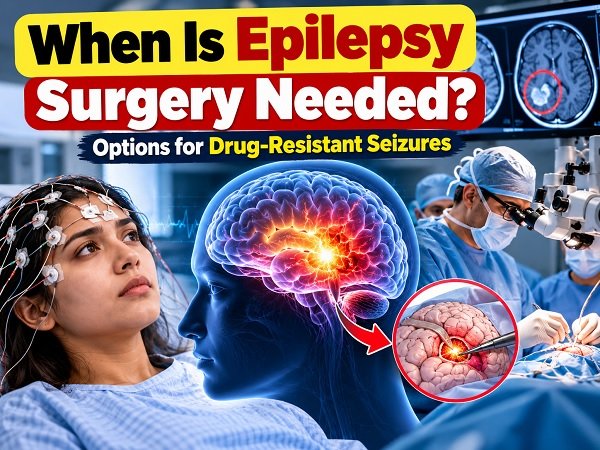
Epilepsy: What Is It?
The neurological condition known as epilepsy is typified by a persistent propensity to experience epileptic seizures. The actual seizure is a brief event brought on by abnormally high or synchronised brain electrical activity.
The appearance of seizures varies greatly from person to person.
They could result in:
- Abrupt loss of consciousness
- Unresponsiveness or staring
- Frequent jerking motions
- Rigidity of the body
- Short-term confusion
- Strange odours or sensations
- Abrupt shifts in behaviour
- Diminished awareness
- Unusual movements of a single body portion
- Temporary issues with memory or speaking
Where and how aberrant electrical activity starts and spreads across the brain determines the type of seizure.
Drug-Resistant Epilepsy: What Is It?
Not all seizures that happen while taking medication are indicative of drug-resistant epilepsy.
First, physicians must ascertain:
- Whether the epilepsy diagnosis is accurate
- What kind of seizures the individual experiences
- Whether the right anti-seizure medication was chosen
- Whether the dosage of the drug was suitable
- Whether the medication was taken on a regular basis
- Whether adverse consequences made treatment insufficient
- Whether there is a particular underlying cause for the seizures
When two suitable and well-tolerated anti-seizure treatment regimens have not resulted in long-term seizure independence, the ILAE criteria typically classifies epilepsy as drug-resistant.
This is a crucial phase because it’s not usually the best course of action to keep trying medicine after many reasonable treatment failures. To find out if surgery or another cutting-edge treatment could be beneficial, a patient may need to be evaluated at a specialised epilepsy center.
When Should Someone Be Examined for Surgery to Treat Epilepsy?
Before considering epilepsy surgery, a person with recurrent seizures shouldn’t necessarily wait many years.
Presurgical evaluation is acknowledged by the ILAE as a crucial component of treating drug-resistant epilepsy.
An examination for epilepsy surgery may be taken into consideration when:
- Despite taking the right medications, seizures persist.
- Two effective anti-seizure drugs have not worked.
- Seizures have a major impact on daily life, work, and education.
- Safety issues including falls and accidents are brought on by seizures.
- An MRI or other tests reveal a possible curable abnormality in the brain where the seizures originate.
- Brain lesions including scars, deformities, or specific tumours are linked to seizures.
- Memory, learning, behaviour, and independence are all severely impacted by seizures.
Getting recommended for an assessment for epilepsy surgery does not guarantee that the surgery will take place. The evaluation aims to decide if surgery or a different treatment is suitable and safe enough.
Early assessment is crucial for several reasons:
Unregulated seizures can impact more than just the seizure episode itself.
Recurrent seizures might disrupt:
- Schooling and educational progress
- Employment
- Driving privileges
- Social engagements
- Cognitive functions like memory and focus
- Emotional health
- Autonomy
- Overall life quality
In children, uncontrolled epilepsy can hinder their educational advancement and overall growth.
Hence, prompt evaluation for drug-resistant epilepsy is essential to pinpoint individuals who could benefit from surgery or other advanced treatment alternatives.
Some common factors are:
1. Mesial Temporal Sclerosis
Changes or damage to the hippocampus in the temporal lobe can trigger repetitive focal seizures.
2. Focal Cortical Dysplasia
This refers to an irregular development of the cerebral cortex, a significant factor in drug-resistant epilepsy, especially in children and young individuals.
3. Brain Tumors
Certain brain tumors can induce seizures. Depending on the tumor’s type and location, surgical intervention might treat both the tumor and the seizure-triggering area.
4. Prior Brain Damage
A previous head injury, stroke, infection, or surgery can result in scar tissue that generates abnormal electrical signals.
5. Vascular Malformations
Conditions like cavernous malformations or specific vascular irregularities might be linked to epilepsy.
6. Other Genetic or Structural Factors
Some patients may have abnormalities not easily detected through standard imaging. Advanced tests may be necessary to pinpoint the root cause.
How Is Surgery for Epilepsy Scheduled?
Surgery for epilepsy is very customised.
The most crucial query is: Where do the seizures start, and is it possible to safely treat that location without creating intolerable neurological issues?
As a result, doctors do a thorough pre-operative assessment.
This could consist of:
1. EEG Video Monitoring
While video recordings capture the clinical characteristics of seizures, the patient may be continually followed using an EEG.
This aids medical professionals in comprehending:
- Where seizures seem to start
- What takes place during the seizure
- The propagation of electrical activity
- Whether the events seen are genuinely epileptic seizures
An essential part of preoperative assessment is long-term video-EEG monitoring.
2. Brain MRI
An MRI using a specific epilepsy technique could reveal structural anomalies like:
- Tissue scarring
- Deformities of the cortex
- Tumours
- Vascular injuries
- Anomalies in the hippocampus
3. SPECT or PET scans
Functional imaging may be useful in identifying brain regions linked to the production of seizures in some patients.
4. Neuropsychological Evaluation
It is possible to assess language, memory, attention, and other cognitive abilities.
This can assist medical professionals establish a baseline before to treatment and comprehend how various brain regions contribute to critical functions.
5. Mapping Functions
Physicians might have to determine which regions are in charge of:
- Language
- Speech
- Movement
- Sensation
- Memory
- Vision
This is particularly crucial when a critical functional zone is near the suspected seizure-producing location.
6. EEG inside the brain
EEG and imaging of the scalp can occasionally be insufficient.
Electrodes may be positioned inside or on the surface of the brain in certain patients in order to more accurately record electrical activity.
The epilepsy team can use this to identify the network that causes seizures and develop a treatment plan.
According to the ILAE, advanced presurgical examination uses instruments including functional neuroimaging, video-EEG, cognitive testing, and intracranial electrodes where needed.
How Can Drug-Resistant Epilepsy Be Treated?
The type of epilepsy, the location of seizure starting point, the underlying aetiology, and the patient’s general health all influence the course of treatment.
Principal choices consist of:
1. Surgery for Resective Epilepsy
When it is safe to do so, the brain tissue that causes seizures is removed during reconstructive surgery.
The objective is to prevent or significantly lessen seizures while maintaining critical brain processes.
This strategy could be taken into consideration when:
- It is easy to identify the area that causes seizures.
- It is safe to remove.
- The anticipated advantages exceed the risks associated with surgery.
2. Laser Ablation
Laser interstitial thermal therapy (LITT) is a minimally invasive method employed in specific instances.
A slender laser device is directed to the specified region, typically with the assistance of MRI. Regulated heat is applied to eliminate the irregular tissue accountable for seizures.
It could be appropriate for specific individuals based on the position and characteristics of the epileptogenic region.
3. Radiofrequency or Alternative Ablative Procedures
In specialized epilepsy facilities, precise ablation methods might be employed to address tissue causing seizures.
The decision is influenced by the individual’s epilepsy condition, body structure, and the technology accessible.
4. Vagus Nerve Stimulation (VNS)
VNS falls under the category of neuromodulation.
A small gadget is surgically placed beneath the skin, typically in the chest, and linked to the vagus nerve in the neck.
The device emits electrical impulses through the vagus nerve to impact the brain networks related to seizures.
VNS does not necessitate the elimination of the brain tissue that triggers seizures.
It is usually considered when seizures persist despite treatment and when surgical removal of tissue is not feasible or has not yielded satisfactory results.
5. Responsive Neurostimulation (RNS)
Responsive neurostimulation represents another type of neuromodulation utilized in specific patients.
The system tracks the brain’s electrical activity and administers stimulation when it detects unusual activity linked to seizures.
This method may be an option for certain patients for whom it is unsafe to remove areas of the brain that cause seizures.
6. Deep Brain Stimulation (DBS)
Deep brain stimulation employs implanted electrodes to convey electrical pulses to particular brain regions.
DBS may be an option for specific patients with epilepsy that does not respond to medication when traditional surgical removal is not appropriate.
7. Dietary Therapy
Some patients, particularly children, might find benefit in specialized dietary strategies like the ketogenic diet.
These nutrition plans should be carried out under suitable medical and dietary supervision.
Dietary therapy is not suitable for everyone, and the selection depends on the type of epilepsy and the patient’s overall well-being.
Brain Tissue Is Not Always Removed During Epilepsy Surgery
For patients and their families, this is a crucial aspect.
The phrase “epilepsy surgery” encompasses various methods.
Treatment may vary, such as:
- Removing unusual brain tissue
- Eliminating a small area triggering seizures
- Severing specific pathways
- Installing a neurostimulation gadget
- Employing precise electrical stimulation to manage abnormal brain functions
Consequently, the treatment strategy is tailored to the person’s seizure patterns and brain structure.
What Are the Advantages of Epilepsy Surgery?
The main aim is to enhance seizure management.
For patients chosen correctly, effective therapy could lead to:
- Decreased number of seizures
- Some patients becoming seizure-free
- Less reliance on urgent medical care
- Enhanced self-sufficiency
- Improved capability to learn or be employed
- Enhanced life quality
- Heightened assurance in daily tasks
Nevertheless, results differ significantly among people. No epilepsy operation can promise total freedom from seizures.
What are the Dangers of Epilepsy Surgery?
Similar to any significant medical operation, epilepsy surgery comes with possible hazards.
These may involve:
- Bleeding
- Infection
- Swelling
- Seizures
- Temporary neurological issues
- Weakness or changes in sensation
- Difficulty with speech or language
- Memory difficulties
- Alterations in the visual field
- Complications related to anesthesia
- Inadequate control of seizures
- Seizure recurrence
The specific dangers vary depending on the specific part of the brain undergoing treatment.
That’s why thorough testing before surgery is crucial.
The decision should be based on a personalized evaluation of the potential advantages and hazards rather than solely relying on a single test or scan.
What Takes Place Following Surgery for Epilepsy?
Postoperative outcomes vary based on the type of surgery performed.
Following surgery, patients might need:
- Monitoring in the hospital
- Neurological checks
- Wound management
- Subsequent EEG or scans
- Anticonvulsant drugs
- Rehabilitation as needed
- Ongoing appointments with the epilepsy specialists
After surgery, anti-seizure medications should never be abruptly stopped unless the treating physician specifically instructs otherwise.
Medication adjustments are typically customised and may take some time, even in cases where surgery is beneficial in controlling seizures.
Can Epilepsy Surgery Eliminate Epilepsy?
The outcome varies based on the specific patient and the form of epilepsy they have.
For certain carefully selected patients, surgery can lead to extended periods without seizures. In different cases, it could notably decrease the number of seizures but not eradicate them entirely.
Individuals who are not suitable for definitive resective surgery might consider neuromodulation or alternative therapies to lower the frequency and intensity of seizures.
Hence, the objective of epilepsy surgery may differ for each patient.
Is Epilepsy Surgery Suitable for Kids?
Yes.
Kids who have epilepsy that doesn’t respond to medication can be considered for surgery.
In some cases, it is crucial to manage seizures early in children as uncontrolled seizures can impact:
- Brain growth
- Learning ability
- Memory function
- Academic achievement
- Behavioral patterns
- Social interactions
The ILAE acknowledges the significance of promptly assessing surgery as an option for children with drug-resistant epilepsy.
A specialized team with expertise in neurology, neurosurgery, imaging, and neuropsychology is typically needed for a pediatric epilepsy surgery program.
When is it advisable to consult with an expert in epilepsy?
Seek specialized assessment if:
- Seizures persist even with medication
- Two suitable drugs have proven ineffective
- Seizures are increasing in frequency
- Medication side effects are challenging to endure
- Seizures disrupt school, employment, or daily tasks
- An abnormality is detected on an MRI
- Uncertainty exists in diagnosing the type of seizure
- Injuries have occurred during seizures
- Concerns arise regarding memory, learning, or development
Being referred for an evaluation does not automatically imply the necessity of surgery. Instead, it allows for a systematic evaluation of treatment options.
Epilepsy Surgery: An Approach Focused on the Patient
The choice to proceed with epilepsy surgery should be determined by a comprehensive assessment involving various specialists.
A standard epilepsy surgery group could comprise:
- Specialist in neurology/epilepsy
- Brain surgeon
- Specialist in neuroimaging
- Specialist in neurophysiology
- Expert in neuropsychology
- Specialized nursing team
- Therapists for rehabilitation if necessary
Together, this team examines the patient’s seizures, brain scans, EEG results, cognitive abilities, and overall well-being.
The main query is: Is it feasible to effectively address the area causing seizures while safeguarding crucial brain functions?
Key Points to Remember
- Drug-resistant epilepsy refers to seizures persisting despite receiving appropriate treatment with effective anti-seizure drugs.
- If two suitable medication plans fail, this is a crucial moment to consider the possibility of drug resistance.
- A diagnosis of drug-resistant epilepsy should trigger a specialized evaluation for epilepsy surgery.
- Epilepsy surgery doesn’t necessarily involve removing a section of the brain.
- Treatment choices may involve various options like resective surgery, laser ablation, VNS, RNS, DBS, and dietary therapy, depending on the specific situation.
- Planning treatment may involve using techniques such as video-EEG, MRI, functional imaging, neuropsychological assessments, and sometimes intracranial EEG.
- The objective is to manage seizures while safeguarding critical functions like speech, movement, memory, and vision.
- Surgery isn’t appropriate for everyone, and treatment decisions need to be tailored to each individual.
- Changing or discontinuing anti-seizure medications should only be done under medical supervision.
When to Consider an Assessment for Epilepsy Surgery
If seizures persist despite correct anti-seizure medications, it might be time to explore the need for a thorough evaluation for drug-resistant epilepsy.
A comprehensive assessment can determine if the seizures originate from a specific, manageable area of the brain and if surgery, ablation, neuromodulation, or another therapy could be appropriate.
Frequently Asked Questions (FAQ’s)
1. Is epilepsy surgery exclusively for individuals with very severe seizures?
Not necessarily. The decision to proceed with surgery depends on factors like the type of seizures, response to medications, the origin of seizures, and the feasibility of treating the area causing seizures.
2. How many medications must be ineffective before epilepsy is classified as drug-resistant?
As per the commonly used ILAE definition, drug-resistant epilepsy is considered when two appropriately chosen, tolerated, and properly used anti-seizure drug regimens fail to provide sustained seizure freedom.
3. Is surgery necessary for everyone with drug-resistant epilepsy?
No. Some patients may be suitable for resective surgery, while others might benefit from ablation, VNS, RNS, DBS, dietary therapy, or alternative treatments. Surgery may not be suitable for all patients.
4. Is epilepsy surgery risky?
Every brain surgery carries risks. However, a thorough pre-surgical assessment is conducted to determine if the potential benefits outweigh the risks for each patient.
5. Can epilepsy surgery completely eliminate seizures?
For some appropriately selected patients, long-term freedom from seizures can be attained. However, outcomes vary, and complete seizure freedom is not guaranteed.
6. Will I require anti-seizure medications post-surgery?
In many cases, yes, at least initially. The decision to reduce or discontinue medication should be personalized and made in consultation with the epilepsy treatment team.
7. What if the region causing seizures is near critical brain areas for speech or movement?
This is a crucial factor. Specialized tests, such as functional mapping, may be employed to identify vital brain regions and determine the safety of treatment.
8. What sets epilepsy surgery apart from VNS?
Epilepsy surgery may involve excising or eliminating a seizure-triggering brain area, while VNS is a neuromodulation therapy that stimulates the vagus nerve without removing the brain tissue causing seizures.
9. Is laser epilepsy surgery less invasive than traditional surgery?
Laser ablation targets specific brain tissue using a small probe and can be less invasive compared to certain open surgical procedures. However, it is suitable for specific patients based on the location and characteristics of the seizure focus.
10. Can children undergo epilepsy surgery?
Yes, children with drug-resistant epilepsy can be considered for surgery when appropriate. Timely seizure control is crucial for their development and learning.
11. What is the typical recovery time after epilepsy surgery?
Recovery duration varies depending on the procedure, the patient’s health, and the treated area. The surgical team can provide a personalized recovery timeline.
12. Can epilepsy return after surgery?
Yes, while some patients achieve long-term seizure freedom, seizures may recur in certain cases. Therefore, long-term monitoring is essential.
13. Should I discontinue my epilepsy medication if seizures persist?
No, it is not advisable to stop or alter anti-seizure medication without medical guidance. Abruptly stopping medication can elevate the risk of seizures.